
Most startups don’t worry about payroll in the early days. The first priorities are obvious: build the product, hire a small team, win customers, and survive. At this stage, payroll is just another admin task. Someone handles it, and nobody thinks too much about it.
The trouble is that this works right up until it doesn’t. A growing team brings changing salary structures, new compliance obligations, and less room for error, and by the time payroll starts causing problems, it’s already taking far more time than anyone budgeted for.
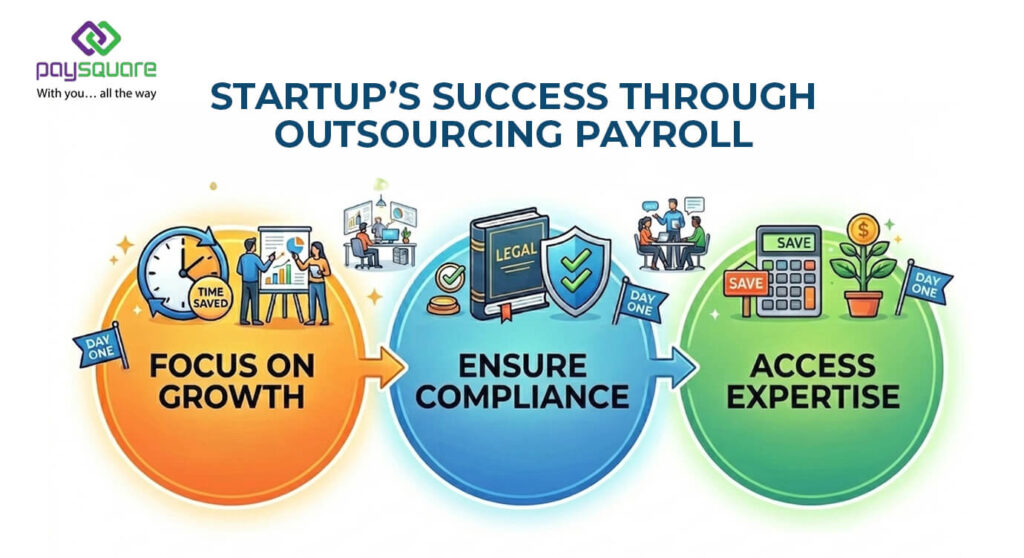
This is the point where founders realise payroll isn’t just a routine task. It’s a process that demands consistency, accuracy, and regulatory knowledge. This is exactly why more companies today are exploring outsourced payroll services for startups from day one, rather than waiting for problems to force their hand.
What Payroll Outsourcing Actually Means
Payroll outsourcing is straightforward in concept. You hand the process to a specialist provider, they run payroll on your behalf, and your team stops worrying about it. In practice, that covers:- Salary processing – consistent accuracy and delivery.
- Payslip generation – structured and compliant.
- Tax deductions – TDS, professional tax, and income tax.
- Statutory filings – PF, ESI, and labor law reporting.
- Employee query handling – to make things easier for your HR team.
Why It Makes Sense Early — Not Just Later
Most conversations about startup payroll management frame outsourcing as something you graduate to once you’re big enough. That isn’t always helpful. The value of outsourcing payroll services isn’t greatest at 200 employees. It’s greatest at 20, when your team is too small to have dedicated payroll expertise, too busy to absorb compliance risk, and too early-stage to afford the cost of getting it wrong. Here’s what early outsourcing actually delivers.Key Benefits of Outsourcing Payroll Services for Startups
1. Compliance Stops Being a Source of Anxiety
Payroll compliance in India is not a set-and-forget exercise. It covers more ground than most people realise, and each piece comes with its own deadlines and its own consequences if missed:- Provident Fund (PF) contributions.
- Employee State Insurance (ESI).
- Tax deductions, including TDS and income tax calculations.
- Labor law compliance reporting.
2. Payroll Errors Drop Significantly
Errors in payroll are rarely catastrophic in isolation. But they erode trust quickly. An employee who finds an incorrect deduction on their payslip or whose salary arrives two days late begins to question the organisation’s basic competence. If it happens twice, the doubt sticks. Small business payroll outsourcing introduces structure and professional accountability into the process so that it can be free of human error.3. The Real Cost Is Often Lower Than Building Internally
It’s a common assumption that outsourcing adds cost. For payroll, the comparison needs to be made honestly. Managing payroll in-house requires:- Payroll software licenses
- Personnel with compliance and tax knowledge.
- Ongoing updates as regulations change.
- Time spent by senior staff on processing and queries.
4. Growth Doesn’t Break the Payroll Process
Startups don’t grow on a schedule. The payroll setup that worked fine for a lean team starts showing cracks in the form of missed steps, slower processing, and queries that fall through the gaps. This is where payroll outsourcing advantages become particularly clear:- Workforce changes get absorbed without internal disruption.
- Adding 10 or 100 employees doesn’t require rebuilding how payroll runs.
- The process stays consistent regardless of changes in the number of people being added to the system.
5. Employees Experience Payroll as Reliable and Transparent
Most employees never think about what happens behind the scenes to get their salary processed. What they do think about is whether the money arrived on time, whether the numbers on their payslip add up, and whether someone actually picks up the phone when something looks off. Good payroll processing services are built for exactly that experience:- A clear channel for employee queries, with responses that actually come through.
- Payslips that break down every component are easy to understand.
- Prompt resolution of discrepancies.
6. Sensitive Data Stays Protected
Salary figures, bank account details, tax records, and personal employee information — payroll sits on top of some of the most sensitive data a company holds. It deserves more protection than a shared spreadsheet and a basic HR tool with default settings. Most founders don’t think about this seriously until there’s a reason to, and by then the exposure has already existed for months. Reputable payroll service providers for startups operate with:- Defined data security frameworks.
- Role-based access controls.
- Audit trails for all payroll transactions.
- Protocols designed specifically to protect employee information.
How Paysquare Supports Startups
Paysquare has been delivering payroll outsourcing and compliance services in India for over two decades. With a team of more than 800 payroll professionals, compliance specialists, and HR consultants, they support organizations ranging from early-stage startups to large multinational enterprises. What sets Paysquare apart:- Deep regulatory expertise across Indian labor and tax law.
- Proprietary payroll technology built specifically for accuracy and compliance.
- Customised solutions designed for organizations at every stage of growth.
- A governance model built around data security and process integrity.


