
Payroll is a significant part of being an HR, and it doesn’t forgive mistakes the way most other tasks do. Missing a statutory remittance deadline and you’re looking at penalty notices, interest charges, and some uncomfortable conversations with finance. That’s the nature of payroll. Low visibility until something goes wrong.
Getting comfortable with the payroll cycle, what it involves, where it tends to break down, and why each step matters is one of the more practical things an HR professional can do. So here’s the full picture.
What Is a Payroll Cycle, Actually?
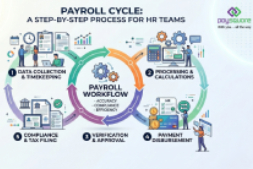
At its most basic, the payroll cycle is the recurring process of paying your people, and everything that happens before and after that payment goes out.
It’s not just the salary transfer. The cycle covers:
- collecting attendance data,
- calculating what each person is owed,
- deducting the right statutory amounts,
- getting approvals,
- disbursing funds,
- remitting PF, ESI, and TDS to the right government bodies, and
- keeping records clean enough to survive an audit.
In India, most organizations run this on a monthly cadence, partly because it’s practical and partly because it lines up with statutory filing windows. The monthly rhythm is worth mentioning because it creates a kind of forced discipline. After all, another cycle is starting before the last one fully closes out.
The Payroll Cycle Steps, One by One
1. Setting the Period and Collecting Inputs
Every cycle needs defined boundaries:
- When does the pay period start?
- When does it end?
- And critically, by what date does HR need all the inputs from the rest of the organization?
This last question causes more delays than people expect. Attendance data, overtime hours, bonus approvals, new joiner confirmations, and salary revision letters come from different teams, on different timelines, and at least a few of them will be late every month. The fix isn’t chasing people repeatedly; it’s setting a hard cutoff date, communicating it clearly, and building the habit that data received after that date gets processed next cycle.
For each pay period, HR typically needs attendance and leave records (present days, paid leaves, unpaid leaves, leave without pay), any one-time items for that month which include increments, performance bonuses, advance deductions, reimbursement claims, and details on new joiners or exits, since both require pro-rata salary calculations.
2. Calculating What Each Person Is Owed
Once the inputs are in, gross salary computation begins. Gross salary is what’s owed before any deductions. For most employees, this means basic pay plus HRA plus whatever allowances are part of their structure, adjusted for actual days worked.
Someone who joined on the 15th gets paid for half the month. Someone who went on unpaid leave for a week gets that deducted. Simple in theory; tedious to get right across a large employee base.
This is also where arrear calculations come in; if a salary revision went through and wasn’t processed last month, the difference gets added here.
3. Statutory Deductions
The deductions stage is where payroll intersects most directly with compliance, and it’s the part that tends to make HR teams most anxious, and with good reason.
PF deductions work like this: the employee contributes 12% of basic salary, and the employer matches that. Of the employer’s 12%, a portion (8.33%) goes toward the Employee Pension Scheme, and the rest into the EPF account. ESI applies to employees with gross wages under ₹21,000 a month. The employee’s share is 0.75% of gross wages, the employer’s is 3.25%.
TDS is trickier because it changes over the course of the year. At the start of the financial year, employees declare their investments and deductions under 80C, 80D, HRA exemptions, and so on. Based on that, a monthly TDS amount gets projected and deducted. The problem is when employees don’t update their declarations mid-year, or when they submit investment proofs in February that don’t match what they declared in April. The shortfall has to be recovered, usually over the last two or three months of the financial year, which can mean noticeably higher deductions showing up in employee payslips in February. A mid-year review, usually around October, catches most of these gaps before they become an issue.
Professional tax varies by state. Labour Welfare Fund contributions are small but have their own deadlines. Both get missed more often than they should.
4. The Pre-Payroll Check
Before the salary file goes out, there needs to be a review of the full payroll register. This isn’t optional. This is where you catch the employee whose salary doubled because the attendance data was imported incorrectly. The person who resigned two months ago and somehow remains active. The new joiner whose bank account is still blank.
Generate the register, compare it against the previous month, flag anything unusual, and get sign-off from whoever holds authorization authority, typically the HR Head or CFO. Only then does the payment file go to the bank.
5. Disbursement and What Comes After
Once salaries are transferred, there’s still work left. Statutory contributions, such as PF, ESI, and TDS, have to be remitted to their respective bodies on specific deadlines. TDS goes by the 7th of the following month. PF and ESI by the 15th. Professional tax timelines vary by state. Miss these, and you’re paying interest and penalties, which finance will not be pleased about.
Payslips go out to employees, ideally, on the same day salaries are credited. Employees who get their payslips days later inevitably wonder if the numbers are correct. A well-documented process and a clear turnaround commitment for query resolution keep this from taking over the week.
6. Year-End
March is intense for every HR team running payroll. Final investment proofs come in, TDS for the year gets reconciled, Form 16 has to be issued by June 15th, and annual PF and ESI returns need filing. Teams with clean monthly records find this manageable. Teams that deferred fixes and corrections across the year tend to find Q4 exhausting.
When In-House Payroll Stops Making Sense
There’s a certain size – somewhere around 150 to 200 employees, in most cases – where the cost and risk of running payroll entirely in-house starts to outweigh the perceived control. Not because the HR team isn’t capable, but because payroll at scale requires dedicated bandwidth, continuous compliance monitoring, and software that stays current with regulatory changes. Most HR functions aren’t resourced for all three simultaneously.
Specialist payroll providers take on that burden. The internal team keeps oversight; the execution sits with people for whom accuracy and compliance are the entire job.
Paysquare has managed payroll cycles for Indian and multinational organizations for over two decades. If payroll is taking more of your team’s time than it should, let’s talk.
FAQs
1) What is a payroll cycle?
The payroll cycle is the recurring process through which employee salaries are calculated, deductions applied, wages disbursed, and statutory contributions filed, monthly in most Indian organizations.
2) What is the role of HR in the payroll process?
HR owns the data that feeds payroll, such as attendance, leaves, joiners, exits, revisions, and manages the process from collection through disbursement, compliance, and employee communication.
3) What are the main steps in the payroll cycle?
Setting the pay period and input deadlines, collecting attendance and variable data, calculating gross salary, applying statutory deductions, running a pre-payroll review, disbursing salaries, remitting statutory contributions, and distributing payslips. Year-end adds Form 16 issuance and annual return filings.
4) How is payroll compliance maintained in India?
Through accurate, timely calculation and remittance of PF, ESI, TDS, professional tax, and LWF. Regular TDS reviews, quarterly return filings, and staying current with Labour Code updates are part of the ongoing work.
5) How often should payroll be processed?
Monthly is standard for salaried employees in India, partly because it aligns with statutory timelines. Weekly or bi-weekly cycles suit contract-heavy workforces but add to HR’s workload. Whatever the frequency, consistency matters far more than the interval.