
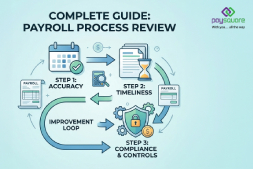
Most businesses only think about their payroll process when something goes wrong, like a missed salary credit, a notice from the EPFO, or an employee flagging a TDS deduction that doesn’t look right on their payslip. By that point, the damage is already done.
The smarter move is to review your payroll process before problems surface, not after.
Regular payroll reviews are important as it ensures operational functionality. This article breaks down what that looks like in practice, what the process should cover, where errors typically hide, and what it takes to keep things accurate as your business grows.
The 5 Basic Steps in Processing Payroll
Any meaningful review has to start with a clear picture of what a healthy payroll cycle actually looks like. In practice, it breaks down into five stages, and the problems usually hide in the handoffs between them:
Collect and verify employee data: Before anything gets calculated, the inputs need to be right. That means current CTC structures, correct bank account details, updated investment declarations, and accurate attendance data for every employee on the roster.
Calculate gross pay: This is where basic salary, HRA, allowances, overtime, bonuses, and variable components come together.
Apply deductions: TDS, PF contributions, ESI, Professional Tax, LWF, and voluntary deductions, each of which needs to be pulled from the correct slab or rate and applied to the right employee category.
Process payments: Net salary goes out, and payslips get issued. In India, most employees expect their salary to be credited by the last working day of the month, without a delay.
File and report: PF ECR uploads, ESI returns, TDS challans, and PT filings cannot be missed. This is vital to avoid penalties and regulatory scrutiny.
What a Payroll Review Should Actually Cover
The most common mistake businesses make when reviewing payroll is treating it as a spot-check rather than a structured process. Spot-checks catch the obvious; a structured review catches the things that have been quietly wrong for three months.
A thorough payroll review and audit should work through the following:
Payroll verification: Pull the active roster and verify it. Stale UAN numbers, employees who’ve been relieved but never deactivated, or contractors being processed under the wrong payroll category are the kinds of things that pop during an inspection.
Reconciliation: Payroll figures should match your financial records exactly. If the salary cost hitting your P&L doesn’t align with what was processed, that gap needs an explanation.
Statutory filing accuracy: Check that PF ECR, ESI returns, PT challans, and TDS filings were submitted on time and that the figures match what was actually processed and remitted. An accurate payroll run can still attract interest and penalties if the challan was delayed.
Deductions: TDS slabs change with every Union Budget, PT rates vary by state and are revised periodically, and PF applicability shifts with workforce changes.
Off-cycle payments: Arrears, bonuses, and full and final settlements processed outside the regular payroll cycle are easy to miss in a review. Each needs to be verified for correct tax treatment and proper documentation.
TDS and Form 26AS alignment: Any mismatch between TDS deducted and what reflects in an employee’s Form 26AS becomes an employee grievance during tax filing season. Catching it during a payroll review is considerably less painful than addressing it after the fact.
Running this review consistently, quarterly at a minimum, not just at year-end, is what separates businesses that stay ahead of compliance from those that get caught off guard by it.
Common Payroll Errors to Look For
Most errors don’t come from negligence. They come from a process design that was fine at 40 employees but started showing cracks at 140. The most frequent ones in Indian payroll include:
Incorrect employee classification: Whether someone is on direct rolls, employed through a contractor, or engaged as a consultant has significant implications for PF applicability, ESI coverage, and TDS treatment. It’s also one of the errors that tends to go unnoticed the longest.
Stale statutory rates: The ESI wage ceiling, PT slabs across states, and TDS rates under the new tax regime are updated more frequently than most payroll teams actively track. Running last year’s logic on this year’s payroll almost certainly means errors somewhere.
LOP and attendance miscalculations: Loss of pay deductions applied incorrectly, or leave balances not syncing properly with the payroll system, are a persistent source of employee disputes and payslip queries.
Payments that don’t reconcile: Duplicate salary runs, missed arrear processing, or F&F settlements not properly closed out typically trace back to a manual step somewhere in the workflow.
Late statutory filings: A missed PF ECR deadline or a delayed TDS challan attracts interest and damages your compliance track record. A pattern of late filings tends to invite closer regulatory scrutiny.
What Drives Payroll Accuracy Over the Long Term
Identifying errors during a review is useful. Building a process that produces fewer of them in the first place is the actual goal. Three things make the biggest practical difference:
Automate what doesn’t need a human: Manual PF calculations, manual PT lookups for employees across multiple states, and manual tax recomputations. These are exactly where mistakes live. The more of this that runs through a reliable system, the less exposure your team carries.
Put a second set of eyes on it before it runs: A mandatory pre-processing review, even a light one, catches the kind of errors that feel obvious in hindsight but get missed when one person is moving fast against a month-end deadline.
Review after any major business change: A new office in a different state, a workforce restructure, an HRMS migration, each of these is a moment when existing payroll logic may no longer apply cleanly. A review of those inflection points prevents small misalignments from becoming large ones.
The Bottom Line
A well-run payroll process doesn’t happen by accident. It’s the result of consistent reviews, honest assessment of where things are breaking down, and a genuine commitment to getting the details right every cycle.
For businesses managing this in-house, that means building processes that outlast any single team member. For businesses that have outgrown their current setup, it may mean asking whether payroll is still the best use of your team’s time at all.
At Paysquare, we’ve spent over two decades building payroll processes that are accurate, compliant, and built to handle whatever comes next, across industries, workforce sizes, and every state-specific statutory requirement in India. If your current process isn’t giving you that confidence, let’s talk.
FAQs
1) Why is it important to review the payroll process regularly?
Statutory rates, TDS slabs, and compliance requirements under Indian labour law change frequently, and a process that was fully compliant last year may have gaps today. Regular reviews catch errors before they attract penalties or employee disputes.
2) How often should a company conduct a payroll audit in India?
Quarterly reviews are considered best practice for most businesses, with a more comprehensive audit at year-end before Form 16 issuance. Companies going through rapid growth or expansion should review more frequently.
3) What is included in a payroll audit checklist?
At minimum, it should cover active roster verification, CTC and deduction accuracy, attendance and LOP reconciliation, off-cycle payment documentation, TDS and Form 26AS alignment, and confirmation that PF, ESI, and PT filings are complete and current.
4) What are the consequences of payroll non-compliance?
Depending on the violation, businesses can face interest charges and penalties from the EPFO or ESIC for late filings, TDS defaults that attract prosecution under the Income Tax Act, and state-level penalties for Professional Tax non-compliance, all of which can be avoided with a consistent review process.