


I have been a client of Paysquare for 7 years and their services are fantastic. Migration from the old…
Delivering Exceptional Experiences














-

4.1
-

4.3
-

4.3
-

5.0

Due to payroll errors, our company failed to comply with the law, so we paid the penalty.
How can we ensure that our payroll- related statutory compliances are accurate?

It is challenging to stay on top of India’s constantly evolving payroll-related income tax rules.
How can we simplify the work of our administrative department and ensure that they are informed of all recent laws and regulations pertaining to payroll?

My organization’s focus is diluted by non-compliance due to payroll errors.
What measures can Paysquare take to ensure compliance with organizational objectives?

We can assist you.

You’ve come to the right place.

Our compliance experts are ready to help you.
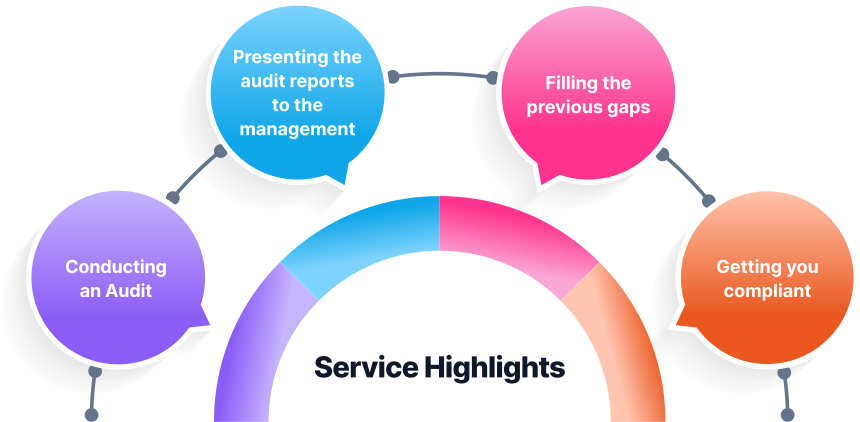

DeliziaHR ensures statutory compliance with all applicable payroll laws and regulations, such as those governing minimum wage, overtime pay, and taxes.

It provides automated calculation and deduction of taxes and other Payroll-related statutory deductions from employees’ salaries.

The system allows for the easy and accurate filing of Payroll-related statutory returns, such as PF, ESI, and TDS returns, to ensure compliance with government deadlines.

DeliziaHR maintains accurate records of all payroll transactions and Payroll-related statutory payments, which can be easily audited if required.

The software offers regular notifications and alerts for upcoming Payroll-related statutory statutory compliance Services deadlines, helping organizations to stay on top of their obligations.

It also provides various reports related to payroll statutory statutory compliance services india, giving the organization an overview of its compliance status.

With deliziaHR, organizations can be confident that they are meeting all statutory requirements related to payroll, helping them to avoid costly penalties and fines.

DeliziaHR is a cloud-based solution for human resources services.

Experience in super niche domains of payroll, compliance, and related services. Serving Statutory compliance services in 18+ countries.

Certified for ISAE 3402 (SOC 1 Type 2 (KPMG), ISO 27001 (BSI) GDPR Compliant company

Processing over 4,50,000 monthly employee records across 3000+ customers globally

A strong team of 700+ professionals

A home-grown payroll processing engine

Robust IT infrastructure with 2 data centers for BCP and Disaster Management

Exists for the last two decades

Insurances for E&O, CGL, WC, etc. Cyber Frauds

80% of our clients are associated with us for more than a decade

Frequently Asked Questions
Statutory compliance in HR refers to the legal framework within organizations when treating its employees. It involves adherence to the laws connected with labor, wages, benefits, safety, and health, thereby keeping the company out of legal penalties. Through the statutory compliance services, companies find it easy to sail through this complex sea of regulations.
Compliance’s primary goal is to make sure that a company is operating within the structure of applied laws, regulations, and ethical standards. This basically involves the development of policies and processes to prevent any of the above infringements, detect any that occur, make corrections, and in return protect the company from possible legal risks and promote its good image to its stakeholders. Statutory payroll compliance ensures correctness of wages, appropriate tax deductions, and timely filings.
Statutory compliance services ensure the adherence to a wide range of legal activities. These services normally extend to payroll statutory compliance, labor law compliance, employee benefits administration, filing of returns and reports, handling of statutory registrations and renewals, and advisory services that keep businesses up-to-date with any change in law. Statutory compliance services in Bangalore, Hyderabad, Mumbai, Chennai, Pune, and other cities across India provide expertise in a localized manner to meet the regional regulations.
Statutory compliance is among the most critical functions of HR, one that ensures employment practices—right from hiring to termination—conform to concerned legislation. This would mean proper maintenance of employee records, correct wage and benefit payments to employees, management of statutory filings, and compliance audits. HR departments very frequently collaborate with statutory compliance consultants to keep themselves updated with changing regulations and best practices being followed.
Statutory compliance is the one that makes certain the functioning of a business enterprise under the legal framework drafted by the government. Businesses can be saved from legal encumbrances, monetary fines as well as damages to reputation on the crux of such statutory compliance. Not only this, but compliance also treats employees equally, ensures a congenial working environment, and brings about corporate social accountability. In India, statutory compliance amounts to a vice of ‘Operation with Integrity and Trust’.
The following steps outline the HR compliance process:
Identification of Applicable Laws: Knowing the laws and rules relevant to the business.
Policy Development: Development of policies and procedures in line with these laws.
Implementation: This involves training staff and implementing those policies across the organization.
Monitoring and audit: Regularly review practices, also conducting periodic audits to ensure ongoing compliance.
Reporting and Filing: Preparing and furnishing reports and filings with all regulatory authorities.
Updation Practices: Keeping an update on the legal changes and tweaking the policies in line with these changes.
The statutory compliance of payroll is one of the most important requirements for a business organization to deal with payroll activities: payment of wages accurately and within time lines, correct tax deduction as per statutory laws, and employment laws. It reduces or will even avert the potential legal penalties and financial loss with regard to the company’s reputation. Proper payroll statutory compliance will drive greater satisfaction and ingrain faith into the minds of the workers, thus contributing to a stable and motivated workforce.
Expertise: It means access to specialized knowledge and experience in dealing with complex legal requirements.
Effectiveness: Simplified process and lessened administrative load from internal HR teams.
Risk Management: Minimized chance of non-compliance and, therefore, penalties associated with such.
Cost Avoidance: Non-compliance penalties and legal fees avoided.
Focus on Core Activities: The business can focus on core operations while experts take care of regulations.
Wage and Salary Administration: Ensuring that payment is consistent with legal requirements. Tax Compliance: Calculate payroll taxes accurately and pay them in a timely manner. Provident Fund (PF) and Employee State Insurance (ESI)- Handling contributions and filings. Gratuity and Bonus: Computation and payment of statutory benefits. Labour Law Compliance: Adherence to different and diverse labour laws and regulation. Record Keeping: Maintenance of adequate and proper records relating to employees, which would be required in audit processes. Statutory compliance services are delivered in cities such as Bangalore, Hyderabad, Mumbai, Chennai, and Pune.
Kick-Start Your Payroll Outsourcing
Journey With Us.
Let us sit together for a quick walk through of the payroll and HR solutions, we have
on offer for you.