
In today’s digital age, the way we work—and the way we receive our pay—has transformed. For years, payroll service providers and traditional payroll systems have supported businesses in managing salaries, taxes, and employee benefits. But with growing workforces, remote employees, and cross-border hires, companies are looking for smarter, faster, and more transparent ways to handle payroll. That’s where blockchain technology comes in. Blockchain isn’t just about cryptocurrency anymore. It’s becoming a powerful tool to manage workforce payments securely and efficiently.
What is Blockchain in Simple Terms?
Think of blockchain as a digital ledger that immutably records transactions, or at least prevents anyone from tampering with them. Whenever someone makes a transaction, such as a salary payment, the system enters it into a secure block. Once the block fills up, the system links or chains it to the ones filled earlier, giving rise to the name blockchain.
The system remains very secure, fast, and transparent because it operates in a decentralised manner, and no single company or bank controls it.
Why Traditional Payroll Systems Have Limitations
Before diving into the advantages of blockchain, it’s essential to first understand why many businesses—especially those with remote or international employees—are facing challenges with traditional payroll and payroll service providers.
- Delays caused by multiple banks in the process and currency exchanges
- High transaction costs are observed in cross-border payments
- Salary breakdowns not being transparent: in taxes, grade deductions, etc.
- Data privacy must be ensured, as sensitive employee information is involved.
- Manual errors and risk of non-compliance.
With the rise of freelancers, gig workers, and global teams, these problems are becoming even more critical for startups and SMEs.
How Blockchain Payroll Works
Smart contracts power blockchain payroll solutions, acting as digital agreements that automatically execute once specific conditions are met. For example:
- The company enters into a smart contract with an employee to pay ₹50,000 at the end of each month.
- The smart contract checks the employee’s attendance and milestones.
- When conditions are fulfilled, the system disburses payments automatically without human intervention.
- The blockchain documents each of the above steps, making them fully transparent and tamper-proof.
Benefits of Blockchain Payroll for Indian Businesses
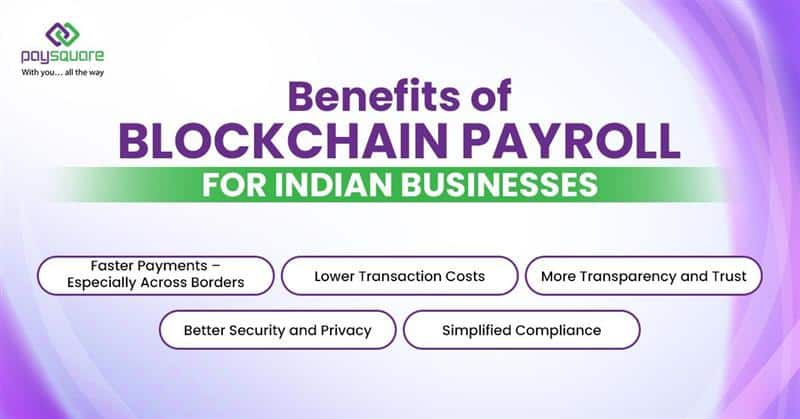
1. Faster Payments – Especially Across Borders
International payments can take three to seven days through banks. Using blockchain, these payments are almost instantaneous, irrespective of the currency used, enabling Indian startups to employ global talent without worrying about delays.
2. Lower Transaction Costs
No middlemen or heavy bank fees. Blockchain reduces costs by disintermediating and employing digital currencies wherever applicable.
3. More Transparency and Trust
The employee and employer can both check every detail: when the company sent the salary, what deductions the company made, and whether any tax was filed. This helps build a little trust and reduces disputes.
4. Better Security and Privacy
Blockchain systems, being encrypted and decentralised, prevent hackers from altering or accessing data. The system keeps salary and sensitive details like the employee’s PAN and Aadhaar secure.
5. Simplified Compliance
Tax reporting, proof of investment (POI), EPF, and other statutory requirements can be built into smart contracts. This ensures automatic compliance with Indian labour laws and reduces human errors.
Blockchain Payroll: Crypto vs Fiat
There exists a misconception; does it rather mean paying in cryptocurrency?
Not always.
Blockchain technology can be used to:
- Record and execute payroll securely.
- Track salary and tax components transparently, and
- Generate audit-ready data.
You might have the payments done in INR or some other local currency and still maintain blockchain as the backend function.
Challenges in Adopting Blockchain Payroll
While the word “blockchain” does sound fascinating, there are, of course, some things businesses need to be wary about:
- Regulatory uncertainty with regard to the use of cryptocurrency in India
- Need for technical infrastructure and training
- Seamless compatibility with existing payroll service providers
- Low awareness and adoption in small businesses
Expert payroll service providers who have a strong understanding of blockchain and Indian compliance can address these challenges through collaboration.
How to Get Started with Blockchain Payroll
Here’s how Indian startups or SMEs can begin the journey:
- Assess Needs: Is your payroll complex or spread across locations?
- Choose the Right Partner: Work with a trusted payroll service provider who offers blockchain integration.
- Start Small: Pilot with a small team or freelance group.
- Ensure Compliance: Align with tax, PF, and labour law requirements.
- Train HR & Finance Teams: So they can manage the new system smoothly.
Paysquare’s View on Blockchain in Payroll
At Paysquare, we believe that the future of payroll lies in digital-first, secure, and compliant solutions. Blockchain can be a disruptive technology to help Indian businesses run and complete workforce payments, mitigating risks, and moving on a global scale.
However, technology must come with compliance, clarity, and expert support. Therefore, powerful Outsourcing Payroll services-back-working from fine technology platform-have always been on offer, giving peace of mind to businesses across India and the world.
Although blockchain-based payroll may still be a novelty in India, it has indeed become a game-changer for international companies. Faster payments, secure data handling, and compliance ease-these are just some of the modern demands of businesses in a digital-first world.
As your company expands, employing persons all over the world or managing gig workers, payroll subsequent to a blockchain can offer them speed, security, and savings.
Now is the time to explore it so as to augment its existing facilities rather than operate on its own.
FAQs: Blockchain Payroll for Indian Businesses
Q1. Is blockchain payroll legal to do in India?
Well, yes. Blockchain technology is legal. However, paying wages with cryptocurrencies may need legal sanction. So, it may be best to pay in INR or the appropriate fiat currency while the back end uses blockchain.
Q2. Do I have to pay in crypto if I use blockchain payroll?
No, you do not. You can pay in INR or other local currencies, while blockchain is simply another way to maintain a clean payroll.
Q3. Is blockchain payroll only for the large companies?
No, on the contrary. They would benefit the smaller and even medium-sized companies. Particularly those who hire freelancers or remote teams.
Q4. Can blockchain payroll make deductions for TDS and PF in India?
Sure. Smart contracts can be written to handle enforcement for compliance, such as deductions for TDS, EPF, ESI, etc.
Q5. How much does it cost to implement?
Costs vary depending on the provider. Some offer blockchain payroll as part of their outsourcing solution at no extra cost.
Q6. What happens if something goes wrong?
Blockchain systems are highly secure and mitigate the chances of errors. Still, it is crucial to work with payroll providers with experience for smooth handling.


