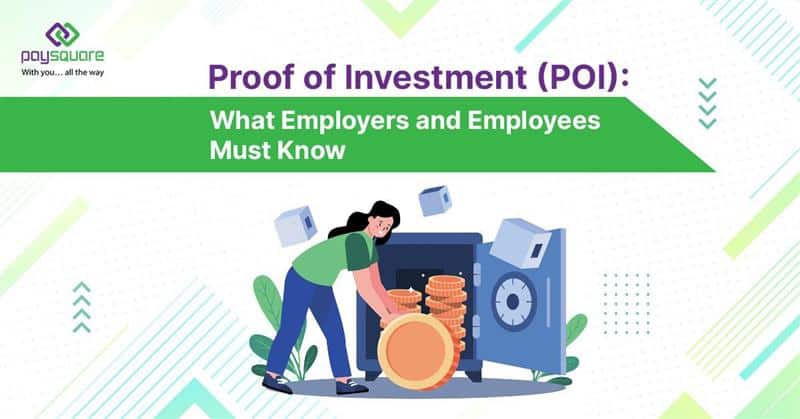
As the financial year comes to an end, Proof of Investment (POI) becomes a common term across workplaces. For both HR managers and employees, understanding POI is crucial to maximise tax savings, prevent excess deductions, and remain compliant with Indian tax laws—something Payroll services help streamline effectively.
What is Proof of Investment (POI)?
Proof of Investments (POI) refers to the documents submitted by an employee to the employer for claiming tax deductions under various Sections of the Income Tax Act (like Sections 80C, 80D, etc.). The employer uses these documents for the calculation of the correct TDS (Tax Deducted at Source) on the salary of the employee.
As part of Payroll services, employees submit proof of tax-saving investments or expenses through POI, which ultimately helps in reducing their taxable income.

Why is POI Submission Important?
For Employees:
- Tax Saving: By declaring and proving tax-saving investments, employees reduce their income tax liability.
- Avoid Excess TDS: Without proper proof, employers may deduct more TDS than necessary, reducing take-home pay.
- Compliance: Helps stay compliant with Indian income tax rules.
For Employers:
- Accurate Payroll Processing: Ensures TDS is calculated correctly based on actual investment proofs.
- Legal Responsibility: As per Indian tax law, employers are responsible for correct TDS deduction.
- Avoid Year-End Hassles: Ensures a smoother financial closing for both payroll and accounting teams.
When Should POI Be Submitted?
Employers usually announce deadlines between December and February for employees to submit POI. If an employee fails to submit it within this period, the employer deducts full TDS from the salary in one or more months during the remaining part of the financial year, generally between January and March.
Note: If POI is not provided to the employer, then one can also claim deductions at the time of filing of the Income Tax Return (ITR), but one cannot avoid the extra TDS already deducted.
List of Commonly Accepted POI Documents
Here are the popular tax-saving instruments and the documents accepted as POI:
Under Section 80C (Max Limit ₹1.5 Lakh):
- Life Insurance Premium: Premium receipt
- ELSS (Equity Linked Saving Scheme): Mutual fund statement
- PPF (Public Provident Fund): Passbook or contribution receipt
- NSC (National Saving Certificate): Certificate copy
- Principal Repayment of Home Loan: Loan statement
- Children’s Tuition Fees: School fee receipt
In Section 80D:
- Health Insurance Premium: Premium receipt (self, spouse, children, parents)
Section 24(b):
- Home Loan Interest Deduction: Interest certificate from bank/NBFC
Section 10 (for HRA):
- House Rent Allowance: Rent receipts, rent agreement, landlord PAN if rent > ₹1 lakh/year
POI & Payroll Processing
Employers adjust monthly TDS based on the POI submitted. Payroll services or outsourcer options, such as Paysquare will automate the procedures:
- Online portals for submitting POIs
- Document verification workflow
- Auto-TDS adjustment
- Employee dashboards to track approval statuses
Common Mistakes to Avoid
- Missing Deadlines: Submitting POI late may lead to excess TDS.
- Invalid Documents: Submitting wrong or expired proofs can lead to rejection.
- Not Declaring Properly in January–February: Initial declaration vs actual submission should match closely.
- Not Updating PAN/Aadhaar: Essential for income tax processing and linking investments.
How Paysquare Simplifies POI Management
Paysquare facilitates both the employer's and employee’s end with:
- Simple portal to upload and verify POI
- It provides mobile-friendly access for the employees.
- Documents are handled with full security and with access assigned only as per defined roles.
- Auto-sync with payroll services to update TDS.
- Alerts and reminders for deadlines.
This reduces HR overhead, avoids manual errors, and ensures full tax compliance.
Conclusion
The Proof of Investment is not an issue limited to documents alone — It is all about good planning. Professionals must timely submit valid POIs to avail taxes and for employers to stay within the law.
If you have a suitable outsourcing payroll services partner, such as Paysquare, the journey is hassle-free, transparent, and error-free.
Let Paysquare take charge of payroll, tax compliance, and employee document management, all under a single roof.
Connect today to make your year-end payroll run smoothly.
Frequently Asked Questions (FAQs)
1. What is the last date for submission of POI?
A company-wise scenario exists, but most companies would set deadlines between January and February.
2. What if I fail to submit a POI?
The employers will collect TDS at a maximum rate while filing your ITR; you can claim your deductions, but excess TDS is subject to no refund.
3. Can POIs be submitted online?
Yes, a lot of companies have adopted payroll software/portals to make POI submission easy for their employees.
4. What happens if my POI documents are rejected?
You will be informed by the HR/payroll team. You can resubmit respondent documents or valid documents to meet the deadline.
5. Are scanned copies acceptable for POI?
Yes, scanned or PDF copies are, in most cases, accepted by employers unless they insist on photocopies of original documents.
6. Do I need to submit POI even if I declared my investments earlier?
Yes, a declaration is different from proof. You must submit actual documents later to validate your claim.
7. Can I claim a deduction later, provided I miss the POI declaration deadline?
Yes, you can claim during the filing of your returns for income tax, but your employer cannot reverse the excess TDS already deducted.
8. Is Paysquare legit for Indian taxation of POI?
Absolutely! Paysquare’s systems are periodically updated to accommodate statutory requirements and process payroll accurately.