For businesses of all sizes, efficient payroll management services play a vital role. Any delays or errors in payroll can lead to employee dissatisfaction, compliance challenges, and even financial losses. Whether you're a growing startup or a well-established SME in India, improving your payroll process not only saves time but also reduces risk.
Here are 9 best practices to streamline and improve your payroll operations effectively.
1. Automate Wherever Possible
Manual payroll handling often consumes valuable time and increases the chances of errors. By opting for payroll management services that automate calculations, tax deductions, leave tracking, and payslip generation, businesses can ensure accuracy while minimising monthly effort.
Example: Use payroll services or partner with a payroll service provider like Paysquare to automate end-to-end processes.
2. Stay Updated with Labour Laws
India’s labour laws keep getting changed every now and then-from the PF limits, ESIC rules, minimum wage rules, and TDS rules-penalties follow if not complied with.
Tip: Always check for legal updates and keep your payroll system compliant with government regulations.
3. Maintain Accurate Employee Records
If incorrect information is uploaded, it may result in wrong salary payments or tax filings. Ensure that employee details such as PAN, Aadhaar, bank details, date of joining, etc., remain updated and verified always.
Best practice: Conduct periodic audits of your employee database.
4. Have a Defined Payroll Calendar
Create a comprehensive payroll calendar detailing cutoff dates for attendance, salary inputs, reimbursements, and final disbursal.
Benefit: Everyone involved in payroll, HR, finance, and employees knows the timeline, which reduces last-minute errors.
5. Ensure Data Security and Confidentiality
Payroll data is sensitive. It includes personal info, bank details, and salary structure.
Action Point: Use encrypted systems, role-based access controls, and secure backup systems. Avoid sharing salary info over emails or unsecured platforms.
6. Train Your Payroll Team
The more informed a team is, the better it can handle complexities, from some tax-saving schemes to those employee queries.
Suggestion: Invest in periodic payroll training or workshops for your HR/Accounts team.
7. Integrate Payroll with Attendance & Leave Systems
Payroll often gets delayed when incorrect data flows in from separate system alarms. However, with integrated HR solutions and professional payroll management services, leave balances and attendance data are captured automatically, minimising errors and ensuring timely processing.
Result: Faster, more accurate salary processing with fewer disputes.
8. Regularly Reconcile Payroll Data
Reconcile data before releasing wages-comparing all inputs, such as attendance, overtime, and bonuses, against the outputs, such as the final payslips and deductions.
Why it matters: It helps catch issues before they affect employees or compliance filings.
9. Outsource to Experts
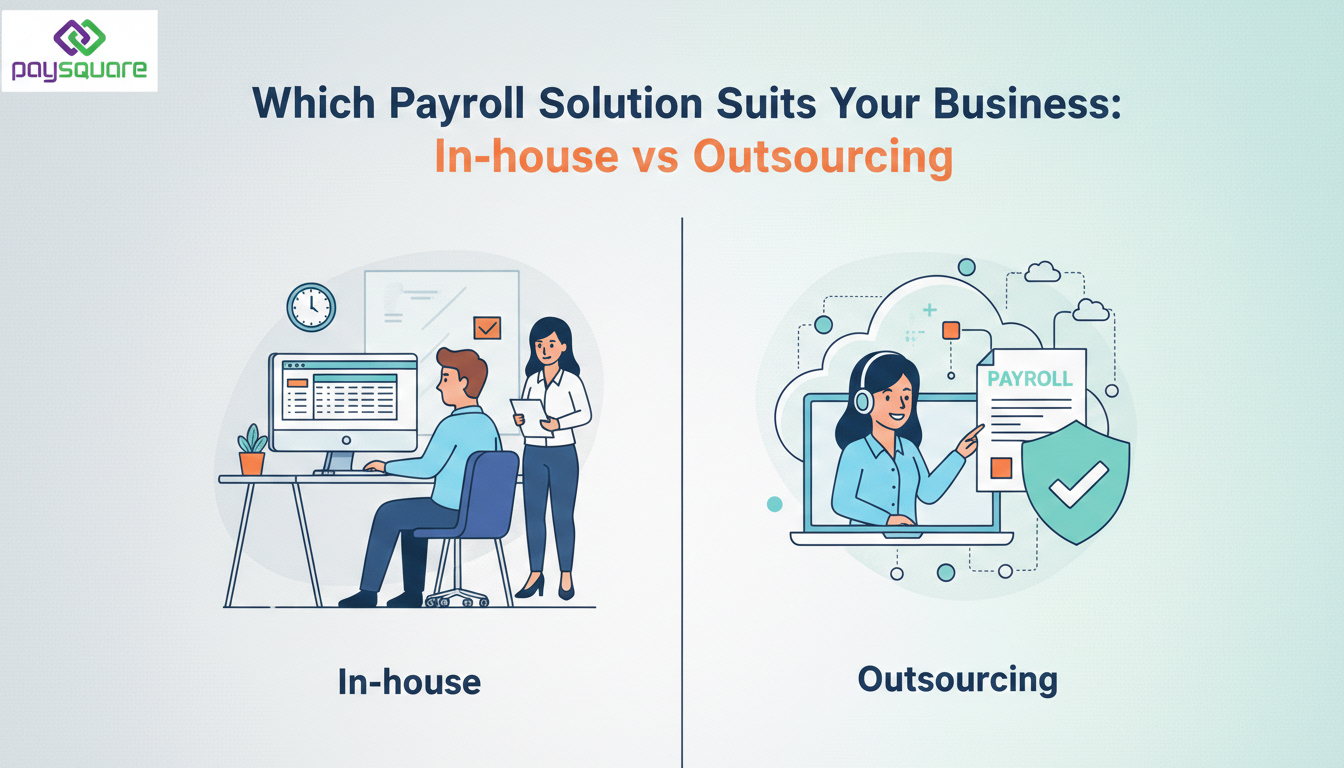
If payroll isn’t your core strength, consider outsourcing to a payroll expert like Paysquare. They bring industry experience, tech-enabled platforms, and compliance know-how, saving you time and money.
Ideal for: SMEs, startups, and growing firms without a full-fledged HR team.
Conclusion
A well-implemented payroll process, supported by professional payroll management services, can foster trust and reinforce a sense of professionalism among employees. By implementing these best practices, Indian businesses will be able to reduce payroll errors, bring about greater compliance, and gear themselves for growth.
Let Paysquare take care of it for you.
From salary processing automation to tax compliance and reporting, our outsourcing payroll services are designed to simplify payroll management for Indian businesses.
Frequently Asked Questions (FAQs)
1. Why must I do payroll automation?
It prevents human error, saves time, and ensures compliance with tax laws and others.
2. Can outsourcing payroll create a benefit for small businesses?
Yes. SMEs probably can save a great deal of time, avoid penalties, and get expert services without needing to staff a full human resources team.
3. How often should employee records be updated?
Quarterly at the least or whenever a change takes place, such as a salary change, a change in the address, or a declaration of new investments.
4. Describe the payroll calendar.
It is basically a calendar of all the important dates for payroll; i.e., dates for attendance cut-off, data collection, salary processing, and bank transfers.
5. What laws must Indian businesses adhere to during payroll?
During payroll, the business must comply with PF, ESIC, PT, TDS, Gratuity, Bonus Act, s & Establishment Act, et Act, etc.
6. What if payroll mistakes occur?
Quickly communicate with affected employees, make corrections, and adjust in the next cycle or via off-cycle payments.
7. What use does integration have in payroll?
When integrated, attendance, leave, and employee data flow into payroll, and there is less duplication and fewer manual errors.
8. Is outsourcing payroll a good cost option?
It opts out of software cost, compliance management, and internal manpower.
9. What security precautions should I consider while guarding payroll data?
Use encryption systems, avoid emails as an input channel, back up regularly, and restrict access to the key personnel.
10. Why does Paysquare rank among trusted payroll partners?
Paysquare is trusted because it provides over 25 years of payroll experience, top-tier automation, data security, and full compliance support to Indian concerns.