In any business, payroll is the ultimate high-stakes game. Precision is everything. From tax deductions to the fine print of statutory filings, the margin for error is basically zero.
As a business scales, leadership has to decide: is managing this internally a strategic use of time, or a liability? An internal team offers proximity and immediate oversight, or should they utilise an outsourced provider that brings structural discipline through experience and expertise?
Ultimately, the right
payroll solution affects more than just processing efficiency.
Why Choosing the Right Payroll Solution Matters
Payroll today is not just salary disbursement. It touches:
- Income tax compliance
- Provident Fund (EPF)
- ESI
- Professional tax
- Gratuity calculations
- Leave encashment
- Bonus and variable payouts
- Multi-state labour laws
According to
EPFO data, India gained 9.79 lakh members who enrolled with EPFO in July 2025. That scale tells you one thing: statutory oversight is real and increasing.
For organisations operating in India, the UAE, or Singapore, payroll complexity increases due to cross-border regulations and reporting standards. This is where the choice between in-house payroll vs outsourcing becomes strategic.
What Is In-house Payroll?
In-house payroll means that the HR or finance department within your company will be responsible for:
- Salary calculations
- Statutory deductions
- Tax calculations
- Compliance filings
- Generating payslips
- Resolving employee queries
Everything will occur internally. It gives you direct control. But control comes with responsibility.
What Is Payroll Outsourcing?
Payroll outsourcing means partnering with a specialised
payroll service provider to manage:
- End-to-end payroll processing
- Compliance monitoring
- Statutory filings
- Tax computations
- Reporting and reconciliations
- Employee payroll support
Paysquare, for example, has been focused exclusively on payroll outsourcing since 2000 and operates with a compliance-first, governance-led delivery model. The difference lies not just in who processes payroll, but in how risk is managed.
In-house vs Outsourced Payroll: A Side-by-Side View
Here’s a clear comparison.
| Parameter |
In-house Payroll |
Payroll Outsourcing |
| Control |
Full internal control |
Shared governance model |
| Compliance Monitoring |
Dependent on internal expertise |
Dedicated compliance specialists |
| Technology Investment |
Software purchase + upgrades required |
Access to advanced, managed payroll platforms |
| Scalability |
Hiring is required as headcount grows |
Easily scalable across locations |
| Risk of Errors |
Higher if person-dependent |
Process-driven and audited workflows |
| Data Security |
Managed internally |
Structured data security frameworks |
| Business Continuity |
Risk during attrition |
Reduced person dependency |
| Multi-country Payroll |
Complex to manage internally |
Designed for multi-geo compliance |
This table reflects the practical reality most CFOs and CHROs evaluate during decision-making.
Compliance: The Deciding Factor
Indian payroll regulations change frequently. Budget amendments, tax regime adjustments, PF wage ceiling clarifications, state-level labour law updates - these are not static.
Organisations face many different key challenges, such as the following:
- Ensuring the confidentiality of their data.
- Skilled payroll processing.
- Completing their payroll process on time with no interruptions.
- Complying with all applicable laws.
- Reducing dependence on staff members.
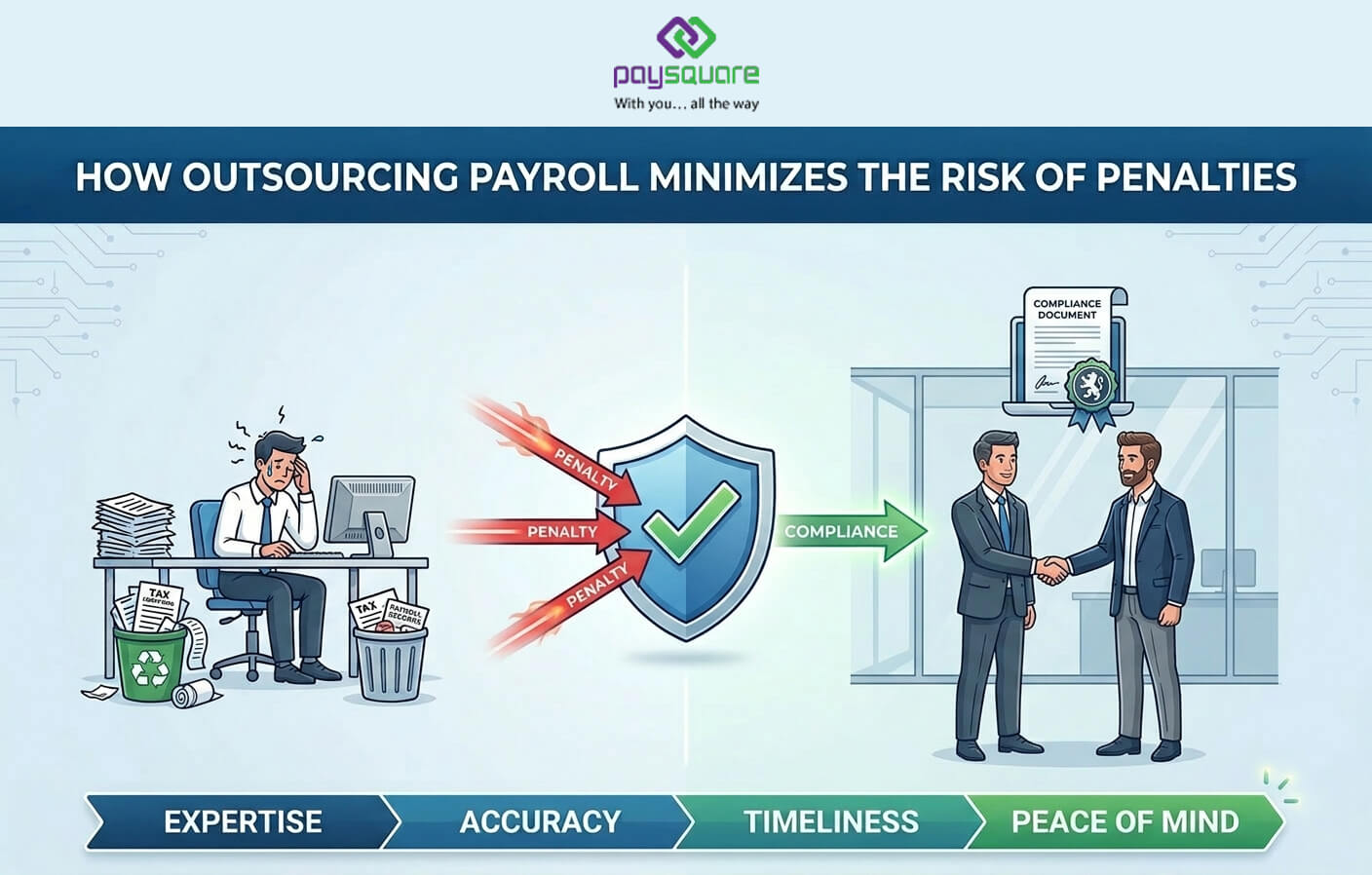
Working with a specialist payroll organisation with compliance experts, audit frameworks, and robust management governance systems ensures that these are no longer challenges.
When Payroll Outsourcing Becomes Strategic
Payroll outsourcing is often a stronger
payroll solution when:
- You operate across multiple states or countries
- Headcount is growing rapidly
- Compliance risk is high
- Payroll queries are increasing
- Leadership wants audit-ready documentation
- You want to remove operational burden from HR
Paysquare supports organisations from emerging enterprises to large Indian and multinational companies, backed by 800+ payroll, compliance, HR, and technology professionals. That scale allows structured delivery without person dependency.
Technology Matters More Than You Think
Modern payroll is technology-driven.
A strong
payroll solution should offer:
- Automated calculations
- Statutory compliance tracking
- Customised workflows
- Employee self-service access
- Secure data handling
- Real-time reporting
Paysquare operates on its own home-grown payroll technology, designed specifically for Indian payroll compliance, while offering customisation flexibility. This is critical because payroll software built for global markets often fails to adapt to India’s dynamic regulatory structure.
Final Thought: Control vs Governance
The debate is not about control. It’s about governance. In-house payroll gives you operational control. Payroll outsourcing gives you structured governance, compliance expertise, and scalability.
The right
payroll solution depends on:
- Your growth stage
- Regulatory exposure
- Geographic spread
- Risk appetite
- Internal bandwidth
For many mid-sized and large organisations,
payroll outsourcing is not a cost decision. It’s a risk management decision.
Paysquare, with over two decades of payroll experience and a compliance-first approach, partners with leadership teams to ensure payroll accuracy, data security, and statutory adherence.
If payroll is becoming complex, expanding, or audit-sensitive, it may be time to reassess your current model.
FAQs
1) What is the difference between in-house payroll and outsourced payroll?
In-house payroll services are provided by a company’s HR or finance department, while outsourced payroll services are provided by a third-party for all employee processing, tax compliance and reporting.
2) Is payroll outsourcing more cost-effective than managing payroll in-house?
In many cases, yes. While outsourcing has service fees, it reduces hidden costs such as compliance penalties, software maintenance, training, and dependency risks.
3) Which payroll solution is better for small businesses?
Typically, very small businesses with few employees can manage payroll through an internal department. However, as businesses grow, payroll outsourcing becomes more effective and scalable.
4) Can payroll outsourcing help with statutory compliance?
Yes. A specialised payroll outsourcing partner will track and keep you informed of any changes to regulations, will provide timely filings, and significantly reduce the risk of non-compliance.
5) What factors should businesses consider before choosing between in-house and outsourced payroll?
Key factors include headcount size, geographic spread, regulatory exposure, internal expertise, technology infrastructure, and risk tolerance.