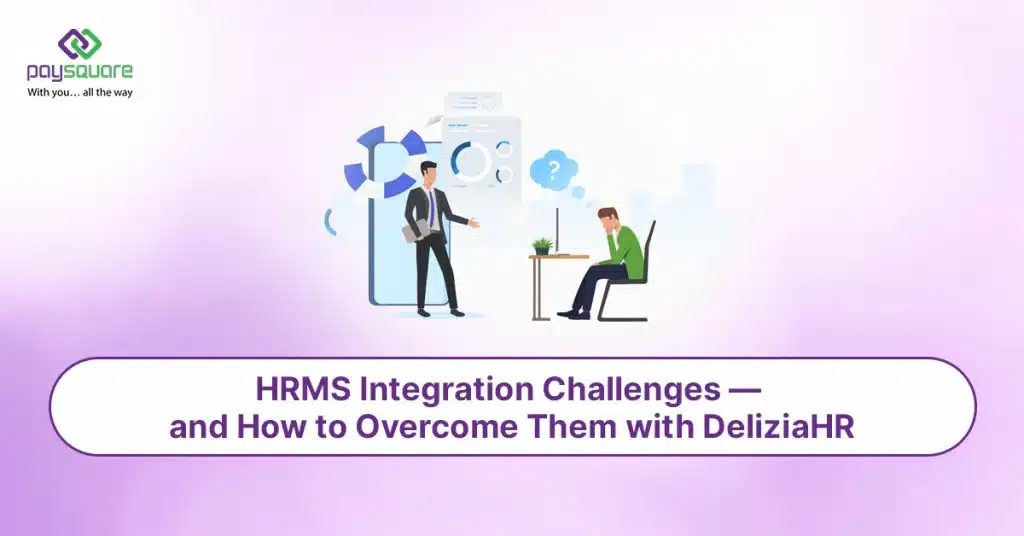
In today’s fast-paced business environment, HRMS integration plays a critical role in connecting recruitment, payroll, attendance, and compliance systems into a single, reliable ecosystem. Even though individual systems deliver the desired efficiency, the absence of seamless integration among these systems might cause data inaccuracies, inefficiency, and compliance risk. DeliziaHR is coming in on these grounds with state-of-the-art integration directorates, essentially to ease HR tasks by ensuring the secure, fast transfer of data.
Common HRMS Integration Challenges
One of the biggest challenges in integrating these HRMS with payroll and other HR platforms is the issue of keeping metrics on par, since the updating of employee records in one system and not in another causes discrepancies to crop up.
1. Legacy Systems and Compatibility Issues
Many organisations still use legacy HR and payroll systems that lack APIs or standardised data in their newer environments. These limitations often create barriers during HRMS integration, making compatibility and seamless data exchange difficult.
2. Security and Compliance Risks
Organisations would risk both breaches and regulatory obligations if HRMS integration does not include strong encryption, data integrity checks, and compliance controls.
3. Migration and Implementation Complexity
Integrating HR with payroll often comes with the challenges of vast volumes of employee data migration, workflow configuration, field mapping, and process engineering. A poor or shallow test could see operational breakdowns, late payroll, and some very dissatisfied employees.
4. User Acceptance and Change Management
Beyond sound integration at the technical level, human factors can play the spoilsport. HR, payroll teams, managers, and employees all need to understand entirely new processes, input requirements, system use, etc. A lack of resistance or lack of acceptance could pose challenges to achieving the expected integrative benefits.
5. Maintenance and Scalability
After establishing the integration, it must not fail to function as the company observes continuous growth. Any monitoring work and maintenance work would one day be used for the expansion of the company into new territory, new departmental entities, or in line with any new regulatory changes. Without governance, further generations of poorly integrated designs are present.
[caption id="attachment_29641" align="aligncenter" width="1200"]
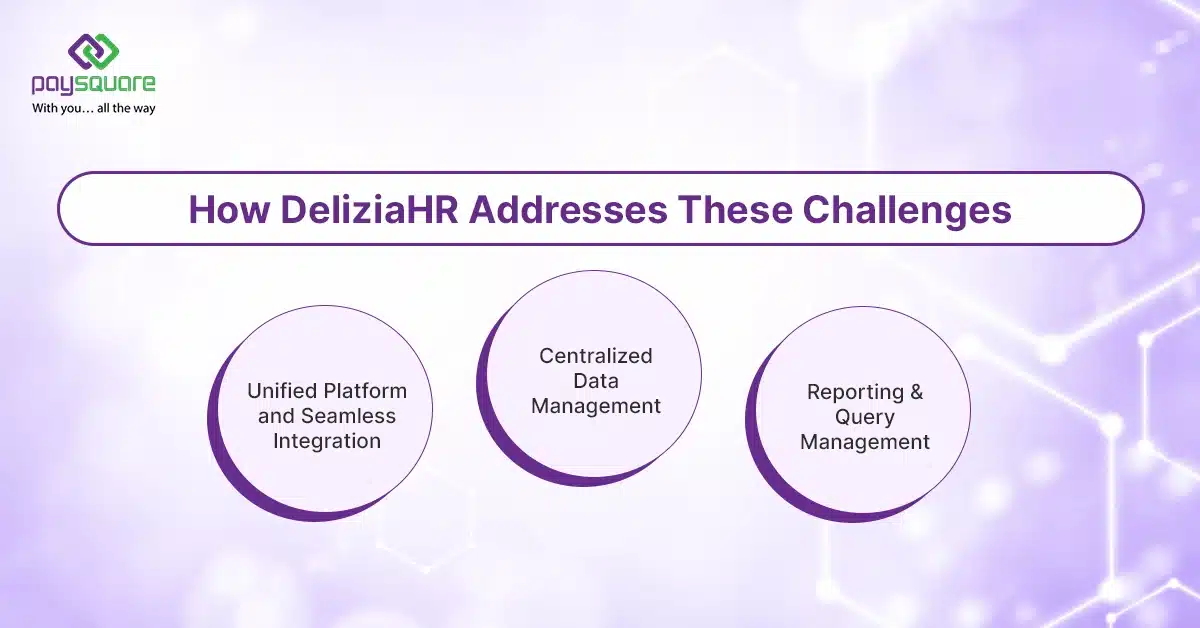 How DeliziaHR Addresses These Challenges[/caption]
How DeliziaHR Addresses These Challenges
1. Unified Platform and Seamless Integration
The major aim was to ensure proper and easy integration with third-party HRMS platforms; all of the employee onboarding, master data, attendance, leave, payroll, and exit management would be integrated in one system.
2. Centralised Data Management
With Outsourcing Payroll services, master records, payroll inputs, attendance data, and leave balances are managed on a single unified platform, ensuring accurate payroll processing and compliant reporting while completely eliminating manual reconciliation efforts.
3. Reporting and Query Management
One of the advantages Human Resources has with DeliziaHR is the traffic toolset, including dashboards, automated alerts, and query management. This enables the HRS to keep an eye on the sufficiency of synchronisation, allowing differences to be noticed and problems to be addressed.
Things To Do For Properly Integrating HRMS with DeliziaHR
Step 1: Outline the Limitations and Data Mapping
The team plans to identify the precise HRMS modules that need integration with DeliziaHR, including employee master data, attendance, leave, payroll, and exit information. They then implement the configuration by defining the required field mapping and selecting the direction of data transfer, whether one-way or bi-directional. Finally, they determine the appropriate time interval for data transfer.
Step 2: Clean and Prepare Master Data
Before the integration process, make sure that the employee records are 100% accurate and complete. DeliziaHR considers data integrity an important factor and encourages regular checks to eliminate discrepancies. Unify the formats of dates, codes, and department names to avoid migration errors.
Step 3: Configure, Test, and Validate
Write the mappings of the fields, and move the data in the test environment. In the runs, you will be able to deal with several permutations created by the more common scenarios, such as entry of the young 'uns, transfers of existing employees, updating of attendance (should the organisation have electronic attendance), and resignation workflows. Validation of data initiates with a cross-verification of data (a triad of accuracy, i.e., timeliness and completeness in a given scenario of data state).
Step 4: Go-Live and Monitor
Integrate with a pilot group or full rollout for the first phase of the integration. Keep an eye on the dashboards for the data to be precise, for any exceptions, and for any delays.
Step 5: Maintain Governance and Scalability
Governance procedures should manage field updates, regulatory changes, and new modules. Regular audits and continuous training for HR, payroll, and management teams ensure accurate, compliant payroll management services. DeliziaHR’s integrated ecosystem supports continuous monitoring and scalable HRMS integration as organisations grow or adapt to change.
Conclusion
HRMS integration brings many challenges - data inconsistency, legacy system limitations, cybersecurity, and user adoption hurdles. DeliziaHR provides a solution with its unified platform, centralised data management structure, strict security rules, configurable workflows, and control settings.
If addressed, the challenges outlined above will lead to fewer mistakes, streamlined processes, easier reporting, and a richer employee experience. Above all, DeliziaHR designs its integration capabilities to ensure that HR systems integrate seamlessly with one another, allowing the organisation to focus more on growth and strategic HR initiatives.