
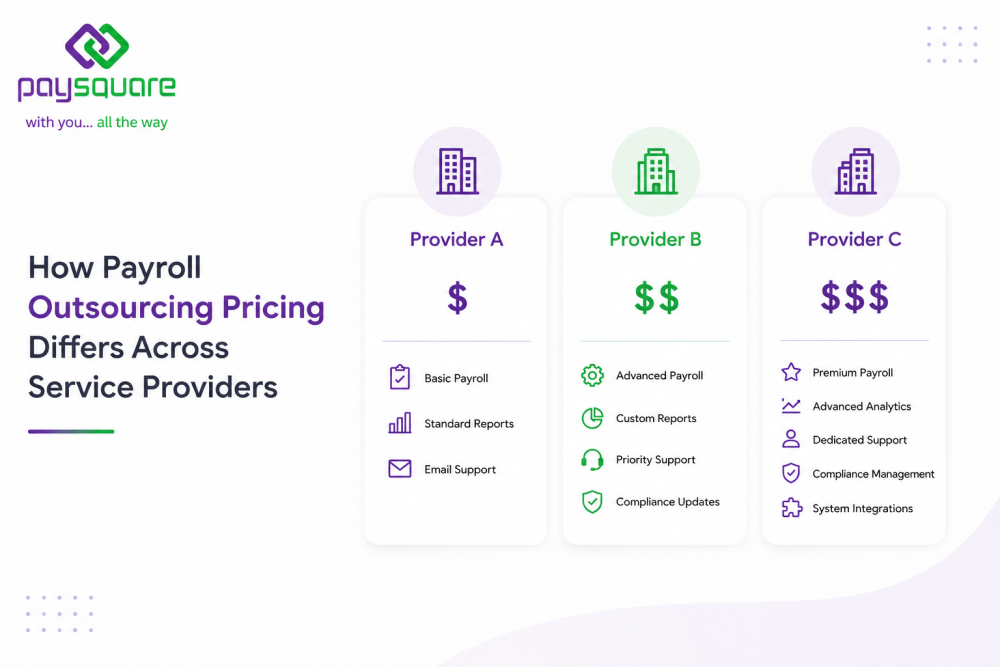
Two providers can quote for the same company and land on figures that are far apart. One charges per employee, another bills a fixed monthly retainer, and a third prices every service as a separate line item.
This is precisely why payroll outsourcing costs are so difficult to compare at face value: the number on a proposal depends entirely on how the provider has chosen to structure it, not on how much payroll the company actually runs.
For finance and HR leaders shortlisting vendors, the structure behind a quote matters far more than the headline rate. A low per-employee figure can end up costing more than a higher one once compliance, filings, and add-ons are accounted for.
Why There Is No Standard Rate Card
Payroll is not a single, uniform task. Calculating salaries for ten employees in one city is a very different undertaking from processing variable pay, multi-state professional tax, and quarterly TDS returns for several hundred.
Providers price for the scope they are asked to absorb, and because that scope varies so widely, the market has never settled on a fixed rate. What looks like an inconsistency between quotes is usually a difference in what each provider has assumed is included.
The Pricing Models Providers Use
Most payroll service providers in India build their fees around one of a few recognized models. Each suits a different kind of organization:
- Per employee, per month (PEPM). The most common structure in the market. A fixed charge applies to each person on the payroll, so the monthly bill rises and falls with the number of employees you carry. It is simple to budget and tends to reward growth, since per-employee rates often step down as the workforce crosses thresholds such as 50, 150, or 500 employees.
- Flat monthly retainer. A single fee covers processing and filings regardless of exact headcount within a band. This works well for organizations with a stable workforce, though it offers less flexibility when numbers move sharply in either direction.
- À la carte or transaction-based. You’re charged service by service. Salary processing is one charge, TDS filing is another, and reporting, if required, is another. A company that needs payroll help, mostly around the March year-end rush, will find this useful. But add up three or four of these line items, and you have often paid more than a single bundled plan would have done for you.
- Bundled or hybrid. One base fee takes care of the routine processing. Then come the extras, billed on top, such as for an audit, registration in a new state, or for a few hours of advisory time. This is the model most large enterprises end up on, and the reason is straightforward: they can budget the base and treat the rest as it comes.
What Actually Drives the Cost
Beyond the model, four variables shape almost every quote:
- Company size. Larger teams generally secure lower per-employee rates because the provider’s fixed operating costs are spread across more pay slips. Smaller organizations carry a higher per-head cost for the same reason, which is why a flat retainer sometimes works out better for them.
- Scope of compliance. Basic salary processing and payslips sit at one end. Full statutory management, covering PF, ESI, professional tax, TDS, statutory bonus, gratuity provisioning, and Form 16 generation, sits at the other end and naturally costs more.
- Operational complexity. Running payroll across several states costs more, because professional tax, Labour Welfare Fund, and Shops and Establishments rules all change from one state to the next.
- Workforce churn. Frequent joiners, exits, and mid-cycle salary revisions raise the volume of work each month, and some providers price for that movement explicitly.
Comparing the Models at a Glance
| Pricing model | Bill scales with | Best suited to |
| Per employee, per month | Headcount | Growing teams with changing numbers |
| Flat monthly retainer | Fixed band | Stable, predictable workforces |
| À la carte | Services used | Occasional or seasonal needs |
| Bundled / hybrid | Base plus add-ons | Large or multi-state enterprises |
Where the Real Differences Hide
The headline figure rarely tells the whole story. Two areas deserve scrutiny before any comparison can be considered fair.
The first is statutory inclusion. A quote that covers only salary calculation is not comparable to one that also files PF and ESI challans, manages state-wise professional tax, runs quarterly 24Q returns, and issues Form 16. A provider who omits these is offering partial outsourcing, and the gap will eventually have to be filled, either internally or at additional cost.
The second is everything that sits outside the monthly fee. Setup and data migration charges, customization for complex salary structures, and fees tied to annual audits or government inspections are common, and they are not always visible upfront. The new Labour Codes, in force since 21 November 2025, add another consideration, since the revised definition of wages is expected to raise PF and gratuity liabilities for many employers. A capable provider should model that impact rather than treat it as an afterthought.
The practical step is to ask for an unbundled, itemized quote and to confirm exactly which statutory filings are covered. A like-for-like comparison is only possible once both proposals describe the same scope.
Paysquare offers transparent, scope-clear pricing that covers end-to-end statutory compliance, so the quote you compare is the cost you actually pay.
FAQs
1) Why do payroll outsourcing costs vary between service providers?
Because each provider structures pricing differently and assumes a different scope of work, two quotes for the same company can look very different even when the underlying payroll is identical.
2) What factors influence payroll outsourcing pricing?
The main drivers are company size, the depth of statutory compliance required, operational complexity such as multi-state payroll, and how frequently the workforce changes.
3) How does company size affect payroll outsourcing costs?
Larger organizations usually pay a lower per-employee rate as fixed costs are spread across more pay slips, while smaller teams carry a higher per-head cost and may find a flat retainer more economical.
4) Are compliance and statutory filing services included in payroll outsourcing fees?
Sometimes, but not always. Some providers bundle PF, ESI, PT, and TDS filings into the fee, while others charge for them separately, so it is essential to confirm inclusions before signing


