
Most payroll grievances inside Indian companies don’t start with the salary number. They start with a leave entry. When a casual leave was applied as paid leave, or when the maternity benefit was miscalculated, or when an LOP that shouldn’t have been an LOP.
HR managers know this pattern well. By the 25th of every month, the inbox fills with leave correction requests, and somewhere a payroll team is reconciling balances against a policy nobody seems entirely sure about.
The leave policy as per the labour law in India is a group of policies that include central Acts, state Shops and Establishments Acts, the new Labour Codes (parts of which are still being notified), and internal HR policies layered over all of it. Getting this structure right is what separates compliant payroll from the kind that draws notices.
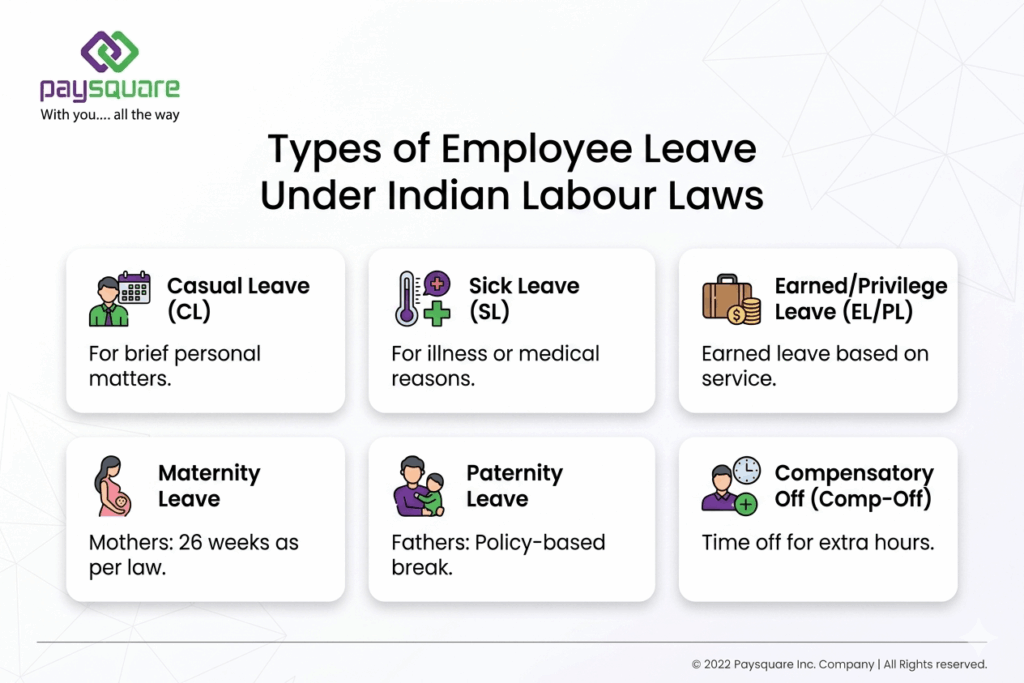
The Main Types of Employee Leave Under Indian Labour Laws
Some leaves are mandated centrally, while others are governed by state law. A few are widely accepted as practice. Here are the different types:
1. Earned leave (also called privilege, paid, or annual leave)
Some leaves are mandated centrally, while others are governed by state law. A few are widely accepted as practice. Here are the different types:
The OSH Code, 2020, lowers that qualifying period to 180 days, a shift HR teams will need to absorb once the Code is fully in force. Most organizations grant 18-24 days annually as a matter of policy, with carry-forward and encashment rules layered on top.
2. Casual leave
CL covers short, unplanned absences such as a sudden sick day, a personal errand, or an emergency at home. It’s governed largely by state Shops and Establishments Acts, with typical entitlements between 7 and 12 days a year.
The catch is that CL usually cannot be carried forward and is not encashable. Treating it like earned leave on the payroll system is a common source of disputes during full-and-final settlements.
3. Sick leave
SL is for medical reasons and is often tied to a certificate threshold (typically beyond two or three consecutive days). State Shops and Establishments Acts again set the floor, with entitlements commonly in the 7-12 day range.
For employees covered under ESI, sickness benefits flow through the ESI scheme, a separate compliance track that payroll teams should map to leave records carefully.
4. Maternity leave
Governed by the Maternity Benefit Act, 1961, as amended in 2017. The entitlements:
- 26 weeks of paid leave for women expecting their first or second child.
- 12 weeks for the third child onward.
- 12 weeks for adopting mothers (where the adopted child is below three months) and commissioning mothers in surrogacy arrangements.
- Crèche facility mandatory for establishments with 50 or more employees.
- Work-from-home option post-leave, where the nature of work permits.
The Act applies to establishments with ten or more employees. Gaps here can become costly, both in terms of monetary penalties and reputational damage.
5. Paternity leave
There’s no central statute mandating paternity leave for the private sector. Central government employees are eligible for 15 days under the CCS (Leave) Rules. Beyond that, paternity leave lives inside the employer’s policy. Most progressive companies now offer 5-15 days, often timed around childbirth or adoption, but it remains a policy benefit, not a statutory entitlement.
6. National and festival holidays
Three are nationally observed: Republic Day, Independence Day, and Gandhi Jayanti. Beyond that, the list of festival holidays varies by state, by industry, and sometimes by the demographic mix of the workforce.
7. Compensatory off
When employees work on a weekly off or a declared holiday, they’re entitled to a day in lieu. The Factories Act and state rules set the framework. Comp-off rules trip up payroll teams more often than they should, particularly in industries with shift patterns or weekend deliveries.
8. Other non-statutory leaves
Marriage leave, bereavement leave, study leave, and sabbaticals are not mandated by Indian labour law. They show up in HR policy because they reflect either company culture or industry benchmarking. It is better to treat them as such on the payroll side.
Where the Leave Policy Meets Payroll
Every leave entry has a payroll consequence. An earned leave availed against a zero balance becomes an LOP. An unmarked LOP becomes a wage error. A maternity leave miscalculated against the Maternity Benefit Act becomes a compliance notice. The link is direct, and getting it wrong is rarely cheap.
Two practices that keep leave-payroll discipline intact:
- Build the leave policy against the applicable statutes first, then layer company benefits over it.
- Reconcile leave balances at the same cadence as payroll close, not at year-end.
For companies running payroll across multiple states, the complexity compounds. Each state adds its own rules, and the new Labour Codes will eventually rationalize this. Until they’re fully in force, HR teams are working with the patchwork.
Getting Your Leave Policy Right
Building a leave policy that holds up against Indian labour law, and translating it into accurate, audit-ready payroll, is the kind of work that benefits from specialists.
Paysquare has spent over two decades helping Indian and multinational organizations align leave policies with statutory requirements and run payroll cleanly against them. If your leave records and payroll aren’t in sync, that’s a conversation worth having.
FAQs
1. What are the common types of employee leave covered under Indian labour laws?
The main statutory leaves are earned leave, casual leave, sick leave, maternity leave, national holidays, and compensatory leave. Paternity leave isn’t centrally mandated for private sector employees and is offered through internal company policy.
2. What is earned leave under Indian labour laws?
Earned leave accumulates based on days worked. Under the Factories Act, an adult worker gets one day off for every 20 days worked, after completing 240 days in a calendar year. The OSH Code, 2020, brings that qualifying period down to 180 days.
3. Why is leave management important for organizations?
Because it touches payroll, compliance, and employee trust at the same time. Inaccurate leave records create wage errors, notices from labour authorities, and disputes at full-and-final settlements, all avoidable with disciplined tracking.
4. How do leave policies affect payroll processing?
Every leave type has a different payroll treatment. Some are paid, some are not, some are encashable, and some affect statutory benefits. A leave policy aligned to labour law makes payroll cleaner and far less prone to errors that surface during audits.


