
Managing payroll is not just about paying employees on time. In India, employers must comply with a range of payroll laws and regulations to ensure legal adherence, avoid penalties, and maintain employee trust. Payroll outsourcing services in India ensure compliance with correct salary calculations, on-time deductions, legal contributions, and proper record-keeping.
Understanding these requirements can be challenging, especially for growing companies or those operating across multiple states. Non-compliance can result in fines, legal notices, or disputes with employees.
Understanding Payroll Compliance in India
Payroll compliance refers to following legal and statutory rules while processing employee salaries, taxes, and benefits. It ensures that the organization follows all rules under Indian labour laws, tax laws, and social security regulations when using payroll outsourcing services in India.
Key objectives of payroll compliance include:
- Timely and accurate salary payments
- Correct tax deductions and contributions
- Transparent record keeping
- Legal protection for both employer and employee
India has multiple laws and regulatory requirements that affect payroll, including the Income Tax Act, the Employees’ Provident Fund & Miscellaneous Provisions Act, Employees’ State Insurance Act, Payment of Gratuity Act, and the Payment of Bonus Act.
Income Tax Compliance
Employers are responsible for deducting Income Tax at Source (TDS) from employee salaries. TDS is calculated based on the employee’s taxable income, exemptions, and applicable tax slab.
Key points for TDS compliance:
- Deduct TDS correctly based on each employee’s Form 12BB or tax declaration
- Deposit the TDS with the government before the due date
- File Form 24Q quarterly to report TDS deductions
- Issue Form 16 annually to employees as proof of tax deduction
Failure to comply can result in penalties, interest, and additional scrutiny by tax authorities.
Provident Fund (PF) Compliance
The Employees’ Provident Fund (EPF) is a mandatory retirement benefit for employees in India under the Employees’ Provident Fund & Miscellaneous Provisions Act, 1952. Employers must contribute a portion of the employee’s salary, along with the employee’s contribution to the EPF account.
Employer responsibilities include:
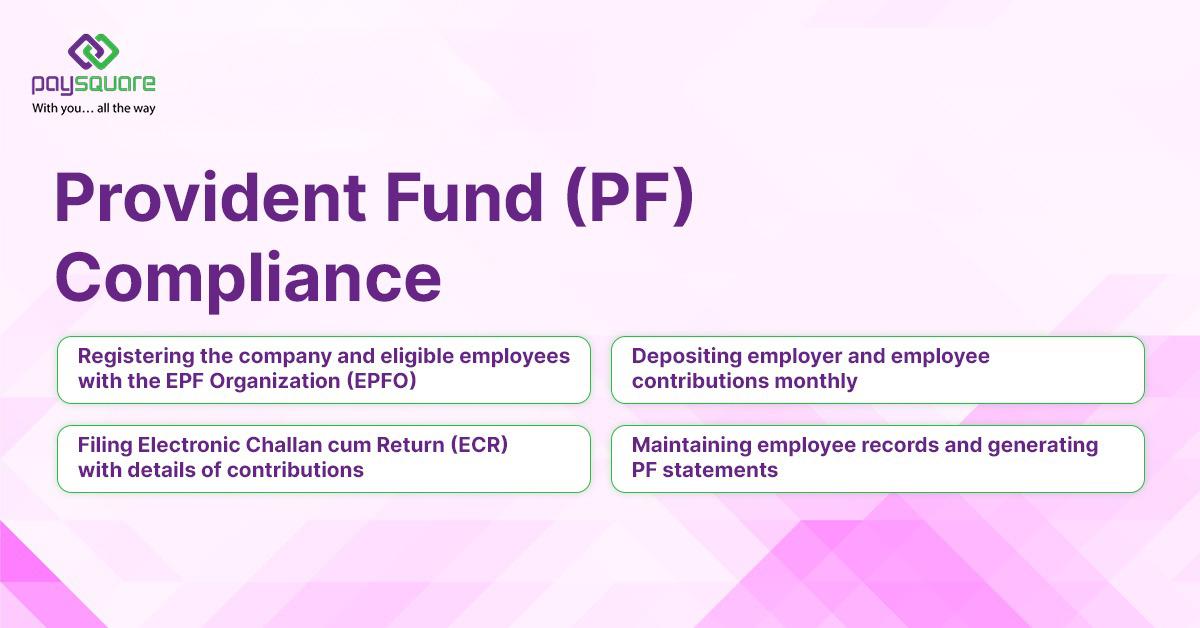
- Registering the company and eligible employees with the EPF Organization (EPFO)
- Depositing employer and employee contributions monthly
- Filing Electronic Challan cum Return (ECR) with details of contributions
- Maintaining employee records and generating PF statements
Non-compliance can result in penalties, interest, and legal action by the EPFO.
Employees’ State Insurance (ESI) Compliance
Employees’ State Insurance (ESI) provides health and medical benefits to employees earning below a specified salary threshold. The employer must contribute a percentage of the employee’s wages to the ESI fund.
ESI compliance requires:
- Registering with the ESI Corporation
- Deducting the employee’s contribution and adding the employer’s portion monthly
- Filing ESI returns on time
- Providing ESI cards and benefits to eligible employees
Failure to comply may result in fines and the denial of employee benefits.
Gratuity Compliance
The Payment of Gratuity Act, 1972, mandates that employers pay gratuity to employees who have completed 5 or more years of service. Gratuity is a financial benefit provided as a reward for long-term service.
Employer responsibilities:
- Calculate gratuity based on the last drawn salary and years of service
- Maintain gratuity records for all eligible employees
- Pay gratuity within 30 days of employee exit or retirement
- File necessary forms with the Gratuity Fund authorities if applicable
Non-compliance can lead to legal claims and financial penalties.
Payment of Bonus Compliance
Under the Payment of Bonus Act, 1965, employees earning below a certain salary threshold are eligible for a bonus based on profits or productivity. Employers must calculate and pay bonuses annually.
Key points:
- Maintain records of employee salary, eligibility, and bonus calculations
- Pay bonuses within 8 months of the financial year
- Ensure minimum bonus percentages are met (currently 8.33%)
- Handle disputes or grievances as per the Act
Failure to comply may result in fines, interest, and legal action.
Minimum Wages Compliance
Employers must adhere to the Minimum Wages Act, 1948, ensuring that employees receive at least the minimum salary set by the government for their industry and state.
Employer responsibilities:
- Pay minimum wages, including allowances and overtime
- Maintain wage registers and records of overtime
- Update wages according to changes notified by the state government
Non-compliance can lead to inspections, fines, or legal action by labour authorities.
Record Keeping and Documentation
Maintaining proper records is crucial for payroll compliance. Employers must store:
- Employee’s personal and salary details
- Tax and statutory deduction records
- Attendance and leave records
- Bonus, gratuity, and benefit details
Good record-keeping ensures transparency, simplifies audits, and protects the company in case of disputes or legal scrutiny.
Challenges Employers Face in Payroll Compliance
Managing payroll compliance in India can be complex due to:
- Frequent changes in laws and tax regulations
- Managing compliance across multiple states or offices
- Errors in manual calculations leading to penalties or fines
- Lack of proper record-keeping and documentation
- Delays in statutory filings affect employee trust
These challenges make it hard for growing businesses to manage payroll on their own, which is why many choose payroll outsourcing services in India.
How Payroll Solutions Help Ensure Compliance
Modern payroll solutions and outsourcing providers simplify compliance by automating calculations, deductions, and statutory filings.
Benefits of using a payroll solution include:
- Automated tax, PF, and ESIC calculations based on the latest laws
- Timely preparation of Form 16, 24Q, ECR, and other statutory reports
- Accurate gratuity and bonus calculations
- Digital record-keeping for audits and inspections
- Real-time dashboards for employee salary, taxes, and compliance tracking
Using payroll outsourcing services in India ensures all legal requirements are met without putting extra work on the HR or finance team.
Best Practices for Payroll Compliance
To maintain full compliance, employers should:
- Keep employee information up-to-date
- Regularly update payroll systems to reflect the latest tax slabs and laws
- Automate statutory deductions and filings wherever possible
- Maintain Secure and organized records for all payroll activities
- Conduct periodic internal audits to verify accuracy
- Train HR and payroll staff on regulatory requirements
- Consider outsourcing payroll to professional providers for efficiency
Following these practices minimizes risks and ensures timely and accurate salary processing.
Why Choose Paysquare for Payroll Compliance
Paysquare is a leading payroll company in India, helping businesses manage end-to-end payroll operations while staying fully compliant with Indian laws. With cloud-based payroll outsourcing solutions, automated statutory filings, and expert compliance teams, Paysquare ensures accuracy, efficiency, and peace of mind.
From handling PF, ESIC, TDS, gratuity, bonus, and minimum wages to providing detailed payroll reports and real-time insights, Paysquare supports organizations of all sizes in staying compliant and building trust with employees.
Paysquare, your trusted partner for accurate, compliant, and efficient payroll management.
Conclusion
Payroll compliance in India is a critical responsibility for every employer. From income tax deductions and provident fund contributions to gratuity and bonus payments, the rules are complex but essential to follow. Non-compliance can lead to penalties, legal disputes, and employee dissatisfaction.
Modern payroll solutions and payroll outsourcing services in India make compliance easier by automating calculations, filing required returns, and keeping accurate records. With the right system or partner, companies can focus on business growth while ensuring that payroll remains accurate, timely, and fully compliant.


