
In the current interconnected world, businesses are increasingly expanding their operations across borders, leading to the complex task of managing payroll for a global workforce. Traditional payroll systems often fall short in handling complex tax laws, compliance rules, and currency conversions, making payroll outsourcing services a more reliable solution.
Introducing Artificial Intelligence (AI), a game-changing development in world payroll outsourcing that aims to simplify procedures, increase precision, and lower expenses. Yet, similar to other innovations, the use of AI in payroll management also brings certain challenges and benefits.
Opportunities in AI-Powered Global Payroll Outsourcing
1. Accuracy and Efficiency
AI-driven payroll systems can process vast amounts of data with precision, minimising human errors that often occur in manual calculations. By automating tasks such as tax computations, deductions, and compliance checks, AI ensures timely and accurate payroll processing across various regions. This efficiency not only reduces administrative overhead but also mitigates the risk of costly mistakes.
2. Accurate Compliance Monitoring
Navigating the complex network of global labour laws and tax regulations can be overwhelming for multinational companies. With the support of payroll outsourcing services powered by AI, businesses can monitor regulatory changes in real time across different countries, ensuring payroll processes stay compliant with local laws. This proactive approach enables organisations to avoid legal risks and quickly adapt to evolving compliance requirements.
3. Cost Reduction
Outsourcing payroll functions traditionally involves significant administrative costs. AI streamlines these processes, reducing the need for extensive human intervention and the associated expenses. By automating routine tasks, companies can reallocate resources to more strategic areas, thereby achieving cost savings and improved financial performance.
4. Scalability
As organisations grow and enter new markets, the scalability of payroll systems becomes crucial. AI-powered solutions offer the flexibility to handle increased payroll volumes and complexities without a proportional increase in administrative efforts. This scalability ensures that businesses can expand their operations seamlessly without compromising payroll accuracy or compliance.
5. Improved Employee Experience
AI enhances the employee experience by providing self-service portals where employees can access their payslips, tax information, and other payroll-related details at their convenience. Additionally, AI-powered chatbots can address employee queries in real time, reducing the dependency on HR personnel and ensuring timely responses.
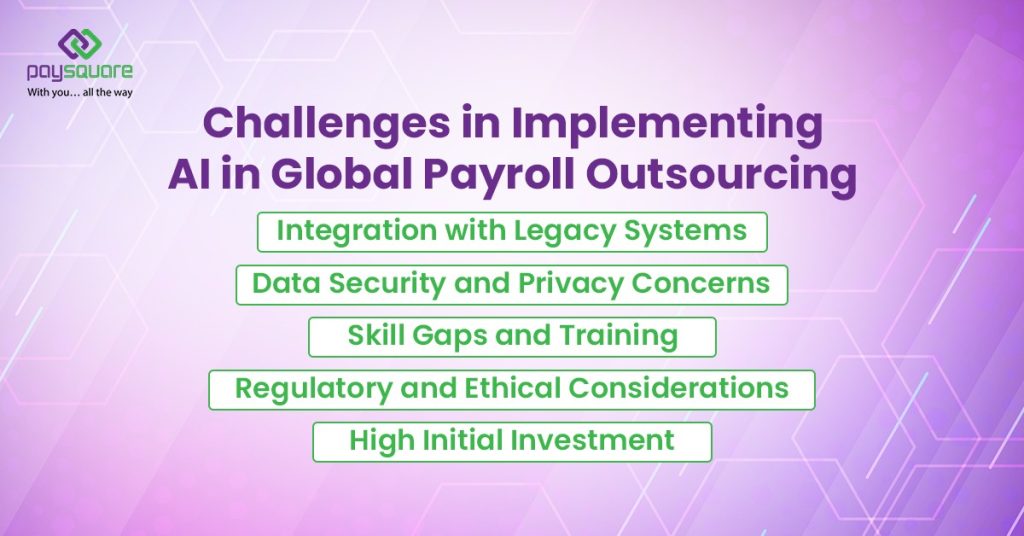
Challenges in Implementing AI in Global Payroll Outsourcing
1. Integration with Legacy Systems
Many organisations operate on established payroll systems that may not be compatible with advanced AI technologies. Integrating AI solutions with these legacy systems can be complex and resource-intensive. Businesses must carefully plan and execute integration strategies to ensure a smooth transition and avoid disruptions in payroll operations.
2. Data Security and Privacy Concerns
Payroll data is highly sensitive, encompassing personal and financial information of employees. The integration of AI in payroll processing raises concerns about data security and privacy. Ensuring robust encryption, secure data storage, and compliance with data protection regulations are paramount to safeguarding employee information and maintaining trust.
3. Skill Gaps and Training
The integration of AI into payroll outsourcing services requires a workforce that possesses the right skills to manage and operate these advanced systems. Businesses may encounter challenges in upskilling current employees or hiring professionals with expertise in AI and payroll technologies. To close these skill gaps, continuous training and development programs are crucial.
4. Regulatory and Ethical Considerations
The use of AI in payroll processing must align with ethical standards and regulatory frameworks. Issues such as algorithmic bias, transparency in decision-making, and adherence to labour laws require careful consideration. Establishing clear guidelines and governance structures is crucial to ensuring ethical AI deployment in payroll functions.
5. High Initial Investment
Implementing AI-powered payroll systems involves significant upfront costs, including software acquisition, system integration, and training expenses. While these investments can lead to long-term savings, businesses must assess their financial capacity and the potential return on investment before embarking on AI adoption.
The Future of AI in Global Payroll Outsourcing
The future of payroll outsourcing is being shaped by AI, predictive analytics, and digital transformation. Key trends include:
1. Predictive Payroll Analytics
AI can analyse historical payroll data to forecast trends in salaries, overtime, tax deductions, and workforce costs. These predictive insights help businesses manage budgets, plan resources effectively, and optimize workforce planning.
2. Personalised Payroll Solutions
AI enables the customisation of payroll processes for individual employees. By considering factors such as tax obligations, benefits preferences, and compensation structures, companies can provide tailored solutions that enhance employee satisfaction and trust.
3. Seamless Integration with Enterprise Systems
AI-powered payroll platforms integrate with HR, finance, and ERP systems, creating a unified view of organisational operations. This integration streamlines workflows, improves reporting, and enhances data-driven decision-making across departments.
4. Automation of Routine Tasks
AI automates repetitive tasks like payslip generation, tax calculations, and compliance checks. This reduces administrative burden and allows HR teams to focus on strategic initiatives such as employee engagement, talent development, and workforce optimisation.
5. Enhanced Security and Compliance
AI supports monitoring compliance with local and international labour law services while ensuring the secure handling of sensitive payroll data. Real-time alerts for irregularities and potential breaches strengthen data security and minimise the risk of fraud.
6. Global Payroll Management
For multinational organisations, AI enhances payroll management services across countries with diverse tax laws and labour regulations. Automated currency conversions, statutory compliance, and reporting guarantee accurate and timely payroll processing worldwide.
Conclusion
Looking for trusted payroll outsourcing services in India? Paysquare offers secure, accurate, and efficient payroll solutions with seamless HR-finance integration, ensuring compliance and enabling businesses to focus on growth.
The integration of AI into global payroll outsourcing offers a plethora of opportunities to enhance efficiency, accuracy, and compliance. However, businesses must navigate the associated challenges, including data security concerns, system integration complexities, and the need for skilled personnel. By strategically addressing these challenges and leveraging the capabilities of AI, organisations can transform their payroll functions into a strategic asset that supports global growth and operational excellence.