
The very nature of the healthcare industry creates a difficult environment characterized by such complications as 24/7 service aspects, irregular hours, and above-normal labor laws.
It complicates payroll management vis-a-vis the treatment of employees on a shift basis, which would depend on a whole other line of payment rules, compliance requirements, and data security issues that antiquated policies don’t accommodate.
A payroll management system can help healthcare bodies to enhance payroll accuracy and also lessen the burden of administration with about 74% of the companies reporting improved efficiency after deployment of such systems. Outsourcing payroll has now emerged as a strategic approach to cutting down on the complexity while improving overall efficiency.
Key Payroll Challenges in the Healthcare Sector
1. Inducements of a Wage System Based on Shifts:
The rotating shifts in healthcare are rife with challenges for formulation of payroll schedules, as most organizations feature night- and weekend-shift work. Given these conditions, overtime, holiday pay, and shift differentials will have to be conveyed well and paid out. More information about shift differentials.
2. High Employee Turnover and Temp Agencies:
The sector of healthcare has a reputation for often changing staff. Temp and part-time jobs eject somewhat inconstant staff. Managing payroll in this never-ending environment without a system in place is anything but easy.
The yearly growth of 6.8% in the payroll outsourcing market promotes various healthcare organizations to come to payroll outsourcing companies to meet their processing needs.
3. Compliance with Labor Laws:
Healthcare institutions need to conform to certain labor laws, such as minimum wage laws, working time limits, and overtime payments. Non-compliance could be punitive. The small businesses in services-70%-benefit from that outsourcing payroll services, as it keeps them compliant with the labor laws of the industry while lessening the potential of expensive payroll errors.
4. Data Accuracy and Security:
The human resources involved in payroll management include much sensitive information about the employees. Healthcare providers who adopt payroll outsourcing services see a 25% faster payroll processing time, with 83% reporting a significant improvement in accuracy.
Ensuring data accuracy and preventing breaches of confidentiality regarding records take precedence. Find out about data security practices
5. Time Tracking and Attendance Management:
Tracking the attendance and leaves of employees from start to finish is necessary to pay the employees properly, considering a 24-hour working atmosphere. More than half of companies are relying on external payroll services, largely with 60% indicating that they are doing so for better management of their employees’ pay and to achieve compliance with their ever-changing tax laws.
Benefits of Payroll Outsourcing for Healthcare
1. Streamlined Shift-based Pay Processing:
When payroll is outsourced, automated pay calculations will take place based on the work done in real-time, leading to a decrease in cross-map checks and administrative workloads illegibly. Find out advantages of payroll automation.
2. Compliance Management Reinforced:
Informed of capricious labor laws and tax regulations, payroll partners keep healthcare groups compliant. According to The Payroll Compliance Survey, 45% of payroll mistakes are due to lack of knowledge in compliance regulations.
3. Spin-Off Efficiency and Core Business Focus:
Outsourcing payroll enables healthcare organizations to put more emphasis on patient care and core operations. Half of healthcare organizations outsource for third party payroll services so they can concentrate on helping patients while the complexities of payroll management are left to someone else.
4. Security and Confidentiality of Data:
Reputable payrollers would have a complete data security arrangement that guarantees compliance with data protection regulations-such as HIPAA. Get the latest press release on that compliance.
5. Scalability to Staffing Fluctuations:
Payroll services are very flexible, allowing considerable adjustments to meet increasingly fluctuating staffing needs arising from either seasonal or crisis demands. Here’s more about calendar planning.
6. Cost Savings:
The reduced costs of in-house payroll personnel and the overhead of mass payroll technology make outsourcing payroll an attractive alternative. Such companies claim to save up to 20% in annual salary management expenses by outsourcing payroll, while 78% claim to have saved considerable time and resources.
How Payroll Outsourcing Simplifies Shift-based Pay Calculations
1. Pay Calculations in Automated Systems:
Payroll systems handle wages and compute complex components such as overtime, bonuses, and differentials automatically. Learn how automated payroll works here.
2. Work Hour Monitoring in Real Time:
The integrated time-tracking tools make sure accurate attendance records, minimizing discrepancies in the payroll processes. The HR Payroll Benchmarking Report indicates that organizations using payroll processing services save an average of 16 hours per week compared to handling payroll in-house.
3. Payroll Solutions as Exquisite as Fingerprints:
Healthcare payroll providers produce unique solutions for particular job functions. This way, salaries are calculated with accuracy. Learn more about customized payroll solutions.
4. Compliance with the Conventions of Union Bargaining:
The providers ensure compliance with agreements between employers and labor unions that guarantee fair compensation for the workers.
5. Management of Centralized Data:
Outsourcing payroll provides central payroll data management that allows for record-keeping and reporting more accurate records. A survey by The National Business Research Institute found that businesses using payroll management services reduce payroll errors by 40%.
Ensuring Compliance with Labor Laws in Healthcare
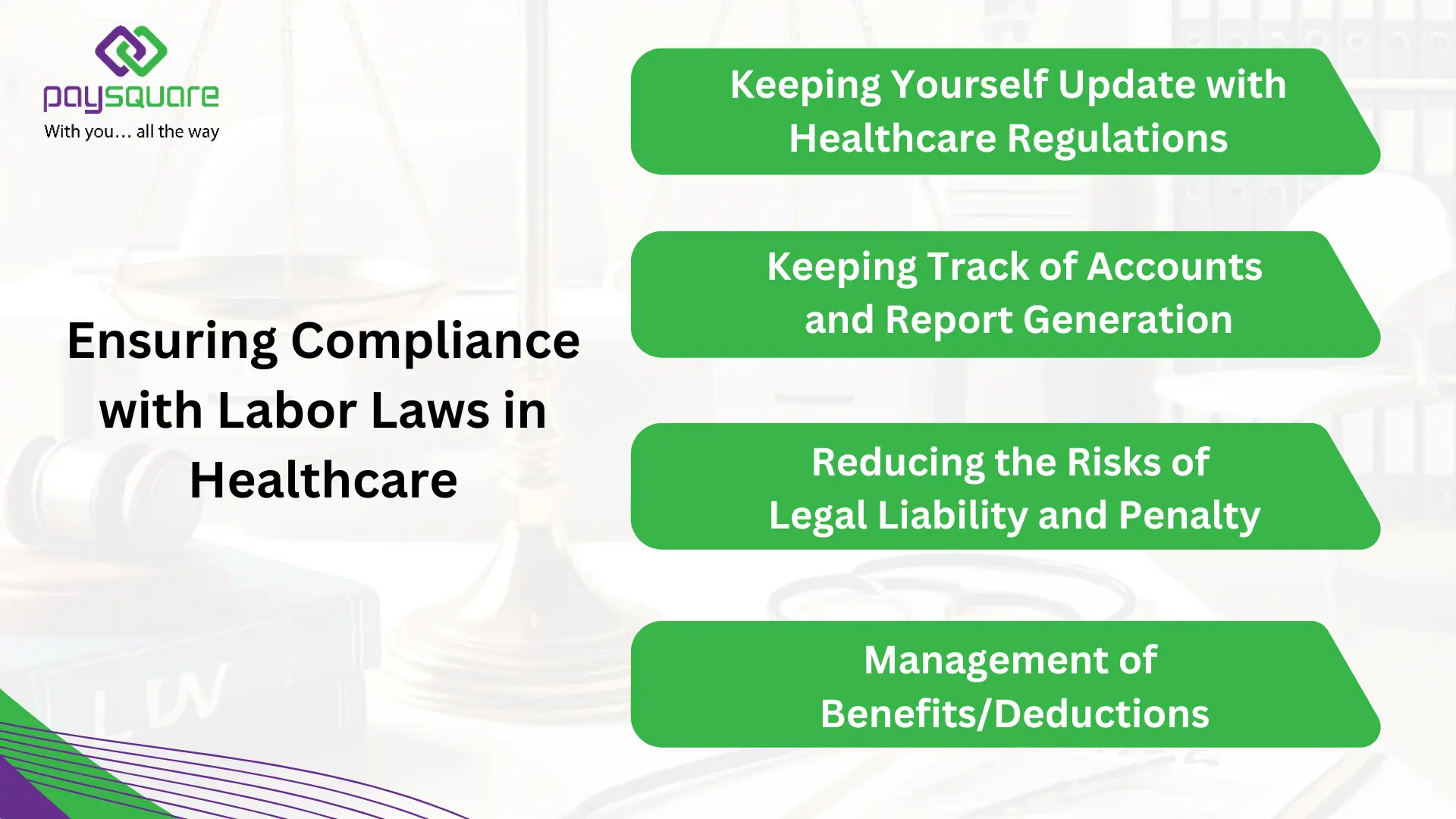
1. Keeping Yourself Update with Healthcare Regulations: For example, payroll providers revamped their service by observing labor law changes and thus continuously supplying their services within the legal aspect.
2. Keeping Track of Accounts and Report Generation: Outsourced services keep impeccable records for legal audits and for tax returns.
3. Reducing the Risks of Legal Liability and Penalty: Accurate payroll management minimises the risk involved in non-compliance, thus minimising the chances of relevant litigation against payroll entities and reducing possible financial penalty costs. A report by ADP reveals that 56% of businesses outsourcing payroll achieve better compliance with local, state, and federal labor laws.
4. Management of Benefits/Deductions: Providers complete calculations of employee benefits and tax with holdings and statutory deductions.
Conclusion
Payroll outsourcing has become the new game-changer in the healthcare industry, unlike many other cumbersome solutions for managing pay on a shift basis and complying with complex labor laws.
Partnering with state-of-the-art payroll service providers allows healthcare organizations to concentrate on quality patient care rather than getting into operational inefficiencies, inadequate data security, or problems related to compliance.