
The Risks of Data Breach in Accounting
The consequences of data outsourcing accounting breaches can be very high, especially involving financial information. Client records, payroll, tax returns, and even future sales and earnings expectations are coveted assets hackers target. For an outsourcing company and its clients, this can result in massive losses, lawsuits, and reputational damage.
The most significant risk is identity theft, which occurs when someone takes financial data and uses it illegally. These activities can be very disruptive to a business and cause the loss of the customer’s trust. Another serious challenge is breaching data protection laws like GDPR or HIPAA Info. They often lead to huge fines and penalties.
Among cybercrime is the large-scale access to clients’ accounts with the view of committing fraud on account manipulation, taking funds for financial payment. In addition to the immediate impact of losing funds, companies risk a more dangerous hit of losing customer confidence due to divulging business secrets and strategies. Manned networks that are not properly secured, poor encryption, or non-existent access controls can be aggravating factors.
Key Principles of Data Security in Outsourcing
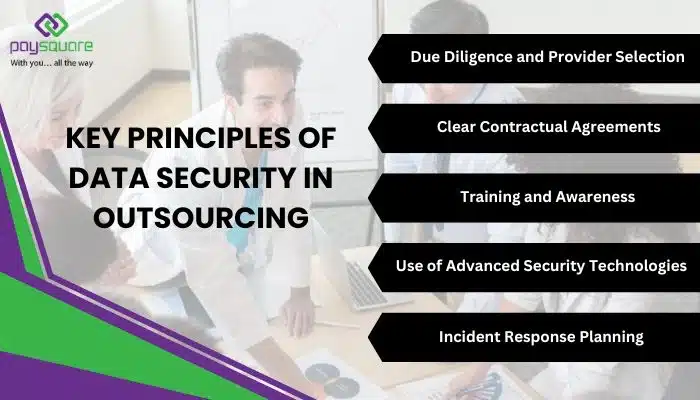
- Due Diligence and Provider Selection
Always check the accounting service provider’s security policies, how they operate with client data & their experience with sensitive information. Engage with providers with ISO27001 certifications or its equivalent because it shows that they are serious about securing data.
- Clear Contractual Agreements
Contracts well drafted explain the roles of the parties, how data should be treated, and the extent to which the data will be protected. Make sure that stipulations are included and clearly outlined regarding the ability of the contractors to control access to the data, timeframes that working teams must adhere to in the event of breaches, and the culpability of both parties in the event of noncompliance or loss of data.
- Training and Awareness
Organizational workers should understand the nature of their jobs and the consequences of not securing sensitive data, which leads to human error in most cases. They should be retrained periodically on the operations of the organization, data security priorities, phishing, and other best practices necessary for the firm.
- Use of Advanced Security Technologies
Data encryption, multifactor authentication, and IDS are implemented as the best practices in this regard that help to secure data at several points. In addition, Providers may also restrict access to unauthorized users by implementing secure cloud platforms and network segmentation.
- Incident Response Planning
Exploiting a vulnerability is bound to occur; having an incident response plan can help mitigate the circumstances. The plan must address procedures for detection, containment, and eradication of security events while limiting the number of adverse effects.
Best Practices for Maintaining Data Security

- Limit Data Access
Limit access to sensitive information on a strictly need-to-know basis. Role-based access control limits access to critical information only to those with authority, thus lowering the chances of insider or wrongful exposure of data.
- Data Encryption
Access control measures, including encrypting data both in transit and at rest, are not only good practice but necessary. Although there is data loss prevention in encryption, Quite several advanced encryption standards called AES also prevent unauthorized viewing of information.
- Secure Data Transmission
Whenever sensitive data is exchanged, encrypted channels should be used to do so. To avoid data loss, virtual Private Networks (VPNs) should be utilized during remote access.
- Regular Software Updates
Often, compromised software is one of the most popular gateways for cybercrime. Updating operating systems, apps, and security tools regularly update patches on known vulnerabilities, thereby protecting the systems from emerging threats.
- Secure Endpoints
Risk-mitigating tools are installed to aid in the prevention of network failures. Such include firewalls, antivirus and intrusion prevention systems as well as devices on the network. Multifactor authentication (MFA) also helps in ensuring that this information does not fall into the wrong hands.
Why Data Security is Important in Accounting Outsourcing
● Protects Financial Information
Outsourcing accounting involves dealing with sensitive information like tax details, salaries, and business activities. Good security facilities are in place, to prevent unwarranted access to this information, their security and confidentiality.
● Mitigates Risks
Data leaks contribute to monetary losses, lawsuits, as well as tarnishing of image and reputation. A data security structure that is sound assures businesses as well as their clients by lowering these risks.
● Ensures Business Continuity
Data breach incidents and cybercrime such as cyberterrorism cause business interruption. Once effective structures of data safeguarding have been put in place, such invasion can be avoided, preventing disruption in the accounting services activities as well as disruption in the rendering of services.
● Attracts Clients
As many clients are careful about data security, they prefer working with outsourcing partners who are ready to protect their data. Once trust is established that sensitive data is protected, it enhances the reputation of the company and as a result, more clients are available.
● Prevents Ransomware Attacks
Ransomware attacks can cripple businesses and organizations, holding their data hostage until they pay a large amount of money. Attacking systems, using systems, and minimizing impact through backups is one method of avoiding ransomware attacks and ensuring that there is no downtime in operations.
● Protects Against Cyber-Attacks
There is a demand for cash all the time, and cybercriminals are always after financial information. Encryption, firewalls and intrusion detection systems are security measures that protect the organization from hackers and help safeguard their data.
Conclusion
It is hard, if not impossible, to overstate the significance of data security in outsourcing accounting services. If financial data is lost or the confidentiality of financial data is compromised, that loss will affect one or more enterprises. In the light of present-day circumstances where financial data is a target for hackers, It is apparent that data security is critical and this criticality must be taken with the utmost seriousness.
Encryption, access restriction policies, regular security assessments, and state-of-the-art technologies should be sufficient to protect businesses from breaches, ransomware, intruders, and other threats, among others. These steps also assure compliance with international statutes, thereby reducing legal liability exposure and increasing confidence among stakeholders.
Risk management and risk mitigation do not encapsulate data security. It is a fundamental aspect of ensuring that the business remains operational. If the sensitive business customer information is prevented from leaking, business activities will not be disturbed, which means the reputation of the company will be sustained and business activity will be uninterrupted. In addition, when prioritizing business customer information, the likelihood of doing business with prospective customers willing to pay for reliable and confidential services increases. The continuous acquisition of best practices and the engagement of accounting outsourcing companies that prioritize data security lay the basis for robust and sustainable growth.
Questions
- What is the significance of data security in accounting outsourcing?
In accounting outsourcing, data security concerns the protection of financial transactions, the trust of clientele, legal risks, and disruptions in business operations. It is essential for maintaining a company’s image and adhering to the standards of data protection legislation.
- What are the primary risks of data breaches in outsourced accounting services?
The effects of data leakages in outsourced accounting services are loss of financial resources, cases of identity theft, loss of compliance with statutory regulations, damage to image, and illegal access to the private information of clients.
- What key principles should be followed to ensure data security in accounting outsourcing?
The key principles include the assessment of accounting service providers, clear contractual obligations, regular internal audits, employee training on security measures, advanced security technologies, and an effective incident response plan in place to uphold any potential breaches effectively.
- What are the best practices for maintaining data security in outsourced accounting services?
Some recommended practices include restricting access, using strong encryption, securing data, regular audits, and access endpoints. These practices help minimize the vulnerabilities and risk of intrusion while guaranteeing those responsible for protecting sensitive financial information the confidentiality and integrity of the processes undertaken.
- How can data encryption protect financial information in outsourced accounting?
Data encryption is important in protecting information by changing sensitive information to unrecognizable symbols during storage and transmission. Even when data is intercepted, encrypted information is not available to those who should not have access to it, therefore the data containing financial records is safe from illegal exposure and infiltration.


