
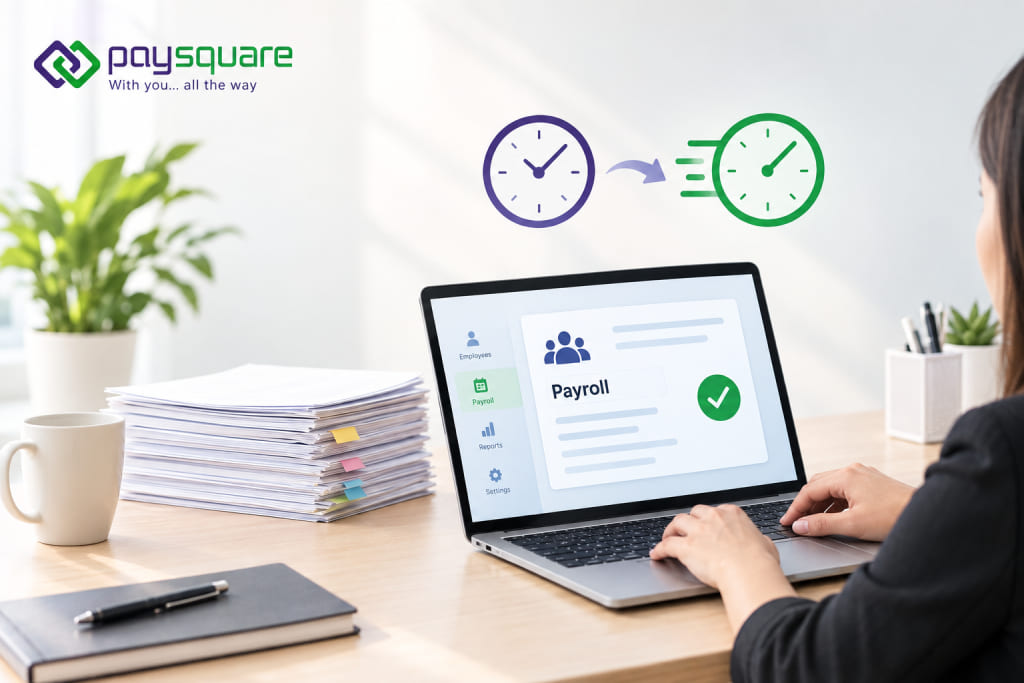
Payroll services for small businesses exist because manual payroll is slow, prone to errors, and can be legally risky.
In-house processing takes about 4 to 10 hours per cycle for a small team, with statutory filings, leave adjustments, and error corrections factored in.
Outsourcing reduces that time by shifting data entry, compliance filing, and salary calculation to a specialist provider, typically reducing the owner’s own involvement down to well under an hour of reviewing and approving numbers.
For a small business in India, that time saved means everything is taken care of, including the tracking of PF, ESI, TDS, and Professional Tax deadlines.
How Does Payroll Outsourcing Reduce Processing Time?
Manual payroll takes time because of everything around the actual math. Calculating leaves, PF, or ESI rate changes manually can take a lot of time to process.
Outsourcing takes each of these tasks off the business owner’s plate. The provider runs payroll through one system. Because the same team runs the same process every cycle, fewer mistakes get made in the first place.
Fewer mistakes mean fewer corrections, and corrections are where in-house payroll loses the most time.
What Made Manual Payroll So Time-Consuming in the First Place?
Most small businesses follow the same pattern. Someone reconciles attendance and leaves by hand. They recalculate loss-of-pay deductions when the numbers don’t match. They work out PF, ESI, and TDS for each employee, one at a time. Then they check the whole file before the salary date.
If there is an addition to the system, then half of the work has to be redone.
The math isn’t the hard part. The hard part is that payroll usually sits with someone who already has five other jobs: a founder, an accountant, an office manager. Payroll is the task that keeps getting interrupted.
What Payroll Tasks Can a Small Business Outsource?
Most providers handle the full cycle, not just the salary math:
- Salary calculation and payslips, including LOP and leave deductions.
- PF, ESI, Professional Tax, and TDS filings, on their monthly and quarterly schedules.
- New joiner and exit paperwork, including full and final settlements.
- Compliance updates, so the business doesn’t have to track every new rule itself.
A business can outsource all of it, or just the statutory filing part. That’s usually where the risk is highest, and the in-house expertise is lowest.
Does Payroll Outsourcing Scale as a Small Business Grows?
Yes, and this is where outsourcing pays off the most.
Going from 10-15 employees to 100 doesn’t require building an internal payroll team. Outsourcing payroll means that the company can easily transition, regardless of the volume. Even if the company moves to multiple locations, outsourcing will make things much easier because they can fully depend on the provider.
A founder who stays with the same provider as the company grows ensures that the payroll processes can grow smoothly alongside.
What Should a Small Business Look for in a Payroll Outsourcing Provider?
Not every provider fits every stage of growth. A few things worth checking first:
- Experience with businesses of a similar size, not just large enterprises.
- Multi-state compliance knowledge, since Professional Tax, Labour Welfare Fund, and Shops and Establishments rules vary by state.
- Integration with the HR or leave tools the business already uses.
- A named point of contact, not just a shared support inbox.
- Clear pricing that doesn’t jump unexpectedly as headcount grows.
The providers that hold up over several years of growth are usually the ones that got these basics right early.
Conclusion
Cutting payroll processing time isn’t really about faster math. It’s about removing the reconciling, chasing, and fixing that eats up hours before the math even happens.
A small business that outsources gets that time back right away, and keeps getting it back as the business grows.
Paysquare works with small and growing businesses across India to run compliant payroll without the hours it currently takes in-house.
FAQs
1. How can payroll outsourcing reduce processing time for small businesses?
It replaces manual data entry and spreadsheet reconciliation with one system and one team running the same process every cycle. Fewer errors mean less rework, and less rework means less time.
2. What payroll tasks can a small business outsource?
Salary calculation, payslips, PF, ESI, TDS, and Professional Tax filings, plus new joiner and exit processing. A business can outsource all of it or just the statutory filing part.
3. Can payroll outsourcing scale as a small business grows?
Yes. The provider absorbs added headcount and new state compliance rules, so the business doesn’t need an internal payroll team or state-by-state research as it grows.
4. What should a small business look for in a payroll outsourcing provider?
Relevant experience, multi-state compliance knowledge, integration with existing HR tools, responsive support, and pricing that stays predictable as the business grows.